
Today marks the 35th observance of Martin Luther King Jr. Day as a federal holiday in the United States, and I feel it fitting to talk about something that is surprisingly related to what the eponymous activist fought for during the Civil Rights Movement in the 60s.
Those of you who know me personally may very well be aware that over the last month and a half I’ve become quite a bit of a hockey nut. I remember watching the Bruins taking on the Maple Leafs in Game 7 in the 2018 playoffs, specifically the third period of the game where Boston stormed back to score 4 unanswered goals to sink Toronto 7-4.
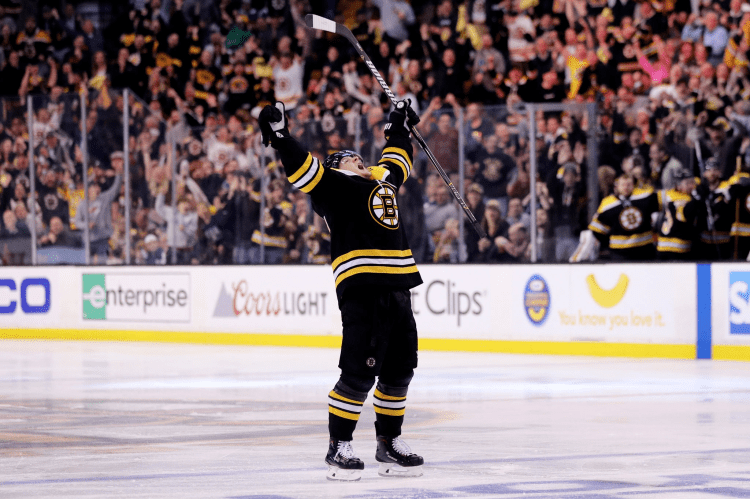
As fun as I had watching that third period (link to that here), not much came from that until I found myself watching the Bruins again the following season as they were in the middle of what would become their franchise-record point streak of 19 games. Then, they made the playoffs, sunk the Leafs again in another series that went to a third game 7 (the first being a now famous series in 2013, game here), went off to grind out a conference semifinal series against the Blue Jackets in six, then swept the Hurricanes in the conference finals to move onto a rematch of the 1970 Stanley Cup Finals against the Blues. Unfortunately, that series ended in heartbreak as the Blues won Game 7 on TD Garden ice.
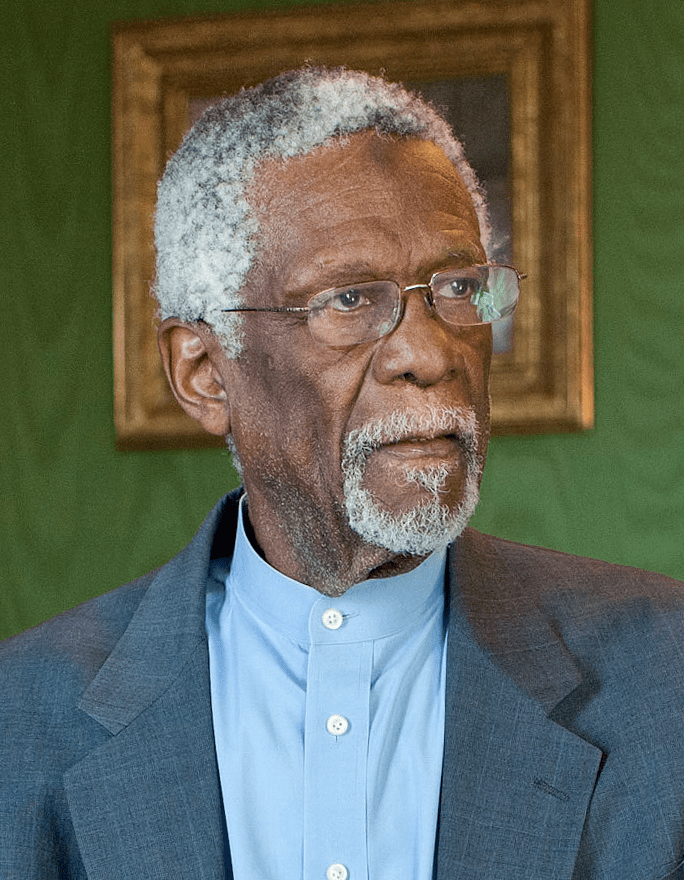
Anyway, back to the subject of the article. At some point over this year and a half I’ve learned that the Boston Bruins were actually the first team in the National Hockey League the first to sign a black player, that player being Willie O’Ree of Fredericton, New Brunswick. It’s interesting to consider how Boston has its own checkered past with regards to racism. The winningest player in Boston sports history, Bill Russell, infamously dealt with it his entire playing and coaching career.
The Boston Red Sox are also infamously tied to racism, having been the LAST team in Major League Baseball to integrate when they called up from the minors Elijah “Pumpsie” Green in 1959, 12 years after Jackie Robinson broke the color barrier in 1947. This largely hinged on team owner Tom Yawkey and general manager Joe Cronin. On the subject of Yawkey, he dubiously refused to integrate during the early days of the color barrier being broken, having passed on Robinson after a tryout at Fenway Park. The tryout itself was also a ruse to appease to de-segregationist councilman Isadore Muchnick to allow the Red Sox to play on Sundays, while Robinson himself was humiliated due to the racial epithets hurled at him. Robinson would later call Yawkey “one of the most bigoted guys in baseball”. Attached to all of this was that from their World Series appearance in 1946 until their next in 1967, Boston failed to even make the playoffs and finished at least ten games behind first in their division, all while other teams began to integrate and achieved success (Keep in mind this starts from 1947, the season where Jackie Robinson broke the color barrier with the Brooklyn Dodgers. Not a great look, Tom!). Despite the long ownership, the current Red Sox organization have distanced themselves from Yawkey, with Yawkey Way reverting to its original name of Jersey Street (and the nearby Commuter Rail station being renamed to “Lansdowne”).

Cronin’s role in all of this is often overlooked. He dubiously passed over Hall-of-famer Willie Mays and never attempted to trade for a black player. Green himself was only called up six months after Cronin left to become the president of the American League. These factors have left the Red Sox with a dubious reputation, which is ironic considering baseball is so racially diverse nowadays (and arguably the most diverse amongst the “Big 4” of sports in the U.S.).
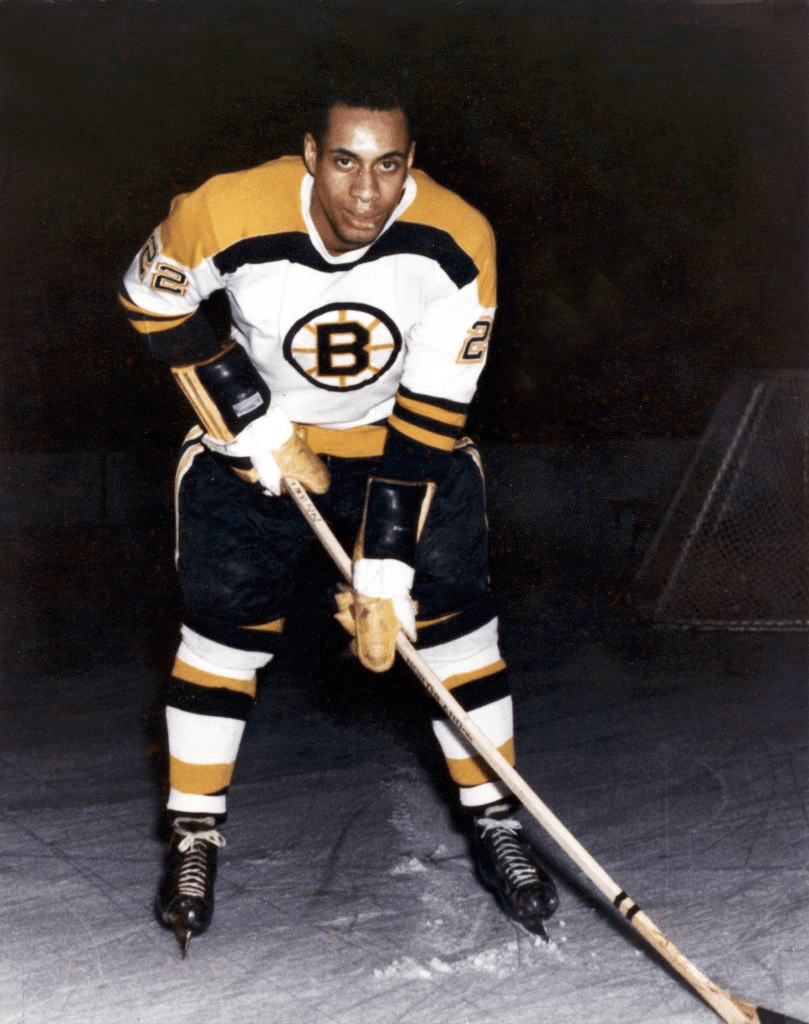
So when you consider how hockey has a dubious reputation of being racially homogeneous, along with everything I’ve mentioned so far, it’s ironic that Boston would be the first to break the black color barrier in hockey. In fact, O’Ree might not have been the “Jackie Robinson” of hockey had he not successfully hid something on the cusp of his debut. Two years prior to his debut, an errant puck got him in the right eye (remember that this was before helmets, visors, face shields, and/or cages were standard at any level), leaving it blind, and had the Bruins known this, he would not have been able to debut. As O’Ree, put it, “Everybody said, ‘you know, you should quit.’ I said, ‘Well I can still see.’ and I just kept on playing.” With just one working eye, O’Ree debuted on January 18th, 1958, breaking the black color barrier in the National Hockey League. Although he only played two games that season, he would return to the Bruins in 1961 and played 43 games before returning to the minor leagues and playing a bulk of his career in the Western Hockey League (WHL) where he won two scoring titles and had his jersey number (#20) retired by the San Diego Gulls.
O’Ree himself will often note that racial epithets still got hurled at him regardless, although it was far worse in the U.S. than in Toronto and Montreal (the only two Canadian cities where the NHL played during his time), saying that fans would yell things along the line of, “Go back to picking cotton!” or “Go back to the South!”. O’Ree would note that his brother told him that “words won’t hurt you unless you let them”, and they ultimately wouldn’t, stating, “I just wanted to be a hockey player, and if they couldn’t accept that fact, that was their problem, not mine.“
O’Ree’s debut predictably had a major impact on the sport, as there have been many black players in the league since his time, although the first to play after him was Mike Marson, who the Washington Capitals drafted in 1974 about a decade later. Other notable black players include Hall-of-Famers Grant Fuhr and Jarome Iginla (the latter who spent most of his career with the Calgary Flames and played briefly with the Bruins for the 2013-14 season) as well as modern All-Stars Dustin Byfuglien, P. K. Subban, Anthony Duclair, Seth Jones, Kyle Okposo, and Wayne Simmonds. In honor of his accomplishments, O’Ree received the Order of Canada in 2008, was inducted to the Hockey Hall of Fame in 2018 as a builder, and inducted to Canada’s Sports Hall of Fame in 2020.
A notable story in the last few years regards former winger Joel Ward. Before taking to the ice against the Pittsburgh Penguins in the 2016 Stanley Cup Finals as a San Jose Shark, he told ESPN that O’Ree was one of his inspirations for playing hockey in the first place, and suggested that his #22 be retired league-wide as #42 was for Jackie Robinson. Although this still has yet to happen, his #22 was officially announced to be retired by the Boston Bruins on January 12 earlier this month.
With this new number retirement, O’Ree becomes the 12th player in Bruins history to receive this honor. He joins the many greats that donned a jersey for the organization, including his former coach Milt Schmidt (who had his #15 retired in 2010). Of course, upon the announcement of the retirement, takes came in. O’Ree himself put up great numbers in the WHL, but his NHL numbers weren’t particularly noteworthy, only putting up 14 points in 45 games and having a plus-minus of 18 (meaning opponents were more likely to score at even strength when he was on the ice). So why give him the honor? The answer is simple: breaking the black color barrier is an achievement that shatters the statistics to bits, so it’s very well deserved regardless. One thing I did worry about, though, was what number newly-signed winger Craig Smith was going to have, as he had been assigned #22 during training camp. Days later, the announcement came that he would switch to #12, allowing the #22 to be properly retired.
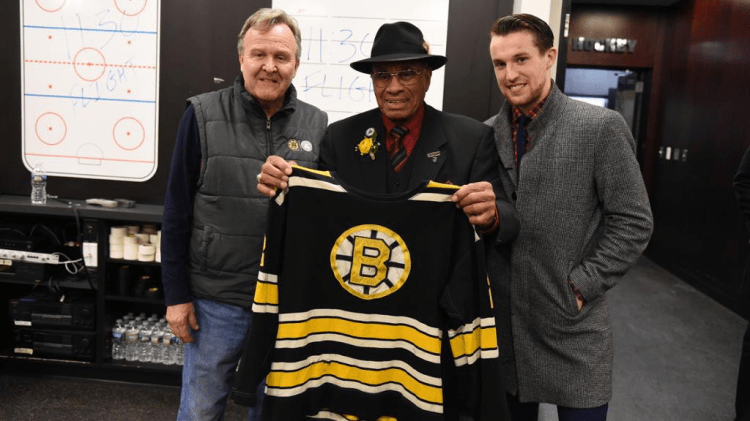
One interesting story regarding O’Ree’s #22 was when he was gifted one of the jerseys he wore as a player by longtime Bruins arena personnel John Grzelcyk (pronounced Grizz-lick in case if you were wondering) and his son Matt (then and current defenseman for the Bruins). The elder Grzelcyk came into possession of the jersey decades ago, although he didn’t realize whose it was until several years before the day he would return it to its rightful owner. There’s quite a bit to this story, but it came on the heels of O’Ree returning to Boston 60 years after his debut in a week of celebrations, and O’Ree was stunned when the Grzelcyks presented him with his game-played jersey.
Months later, it became public knowledge that then-Washington Capitals defenseman Madison Bowey had a reason for choosing his own number in his rookie season: his black father told him of Willie O’Ree and his importance in hockey history, and he seized upon the opportunity to wear #22 in honor of O’Ree’s achievement.
Anyhow, I hope this inaugural post to this blog enlightens you on this important day of remembrance. With the news of O’Ree’s jersey retirement coming out, I knew I had to post something about it, and it’s great that today’s holiday also coincides with the 63rd anniversary of his NHL debut. Happy Martin Luther King Jr. Day, everyone.
ADDENDUM (January 17, 2022)
Hello, readers! I hope you are all doing well.
I’ve decided to add this addendum as we approach the formal retirement of Willie O’Ree’s number to share some additional knowledge I’ve learned since I originally made this post. Before we begin, though, I’d like to make note of one important thing: I’ve edited some parts and terminology in the original post to either be factually accurate or alleviate potential confusion. As such, let’s also bring in some additional information that can help clarify one major point:
Originally, I noted that Willie O’Ree “broke the color barrier”. This phrasing is a bit misleading: in actuality, the color barrier itself had been broken a few years before. Larry Kwong, a Canadian of Asian descent, debuted with the New York Rangers in 1948, getting a shift that lasted less than a minute. Thus, it was Larry Kwong who broke the color barrier as a whole, while O’Ree broke the black color barrier. This should not diminish O’Ree’s accomplishment, though: O’Ree being likened to Jackie Robinson is still a great comparison, as both broke the black color barriers in their respective leagues. The two even met on two occasions: the first was when O’Ree was traveling with his youth baseball team where they were honored in New York. The then-14 year old O’Ree managed to speak with the legend during a visit to Ebbets Field, mentioning that he was also a hockey player which surprised Robinson. About 13 years later, both attended an NAACP luncheon in Los Angeles and Robinson realized he met O’Ree before: “Willie O’Ree – aren’t you the young fella I met in Brooklyn?“
Anyway, here’s a wild story: During O’Ree’s second stint with Boston, he found himself the victim of racial epithets from both fans and opposing players. One such player was Eric Nesterenko, who seemed to enjoy hurling them, and even got physical. After butt-ending O’Ree to break his nose and two front teeth, he got a response in the form of getting hit in the head with a hockey stick that required 15 stitches. Almost instantly, other Blackhawks players and fans in the stands began yelling “every racist name in the book“, with O’Ree stating that he “almost created a riot” and that he “was lucky to get out of the arena alive“.
After his second stint with Boston, O’Ree was traded to Montreal Canadiens, but he never saw NHL ice again, as according to O’Ree, “the team was run by racists” at the time and he wasn’t even invited for a tryout. Word also got out over his right eye being blind, which barred him from ever returning. He then turned to the Western Hockey League as mentioned previously, where he could finally showcase how deceptively good he was as a player.
To understand what I’m about to get into, let’s discuss into a bit of hockey works. Hockey players hold a hockey stick one of two ways: having the left hand on the middle of the stick and the right hand at the top (in which case they are a left-shot), or vice versa (in which case they are a right-shot). This all comes down to preference, and it usually comes down to which hand is seen as the “control” hand: most players also see that the control of a hockey stick comes from the top. As most people are right-handed, most get taught that the right hand goes on top as most see the dominant hand as the “control” hand, meaning that left-shots are more common.
What is the impact of this, then? Which way you shoot also affects which position you play. Most often, unless you play center/centre, players play the position in which side their blade is closest to the boards in the direction of the offense: a left-shot player generally plays on the left side of the ice, and vice versa (again, there are notable exceptions). Thus, most players who play left-wing (left-wingers) are left-shots.
On how this circles back to Willie O’Ree, this is where we get into where he was deployed. Given that he was a left-shot, he initially played as a left-wing. However, given that he mainly played along the left side of the ice and was blind in his right eye, he didn’t have a lot of vision of the ice despite possessing good puck-handling skills and great speed. Upon being switched to right-wing (in which case he began playing on his “off-wing”), the effects were immediate: with expanded vision, he was able to score to levels he hadn’t reached before, which became reflected in his overall numbers in the WHL (not to mention the two scoring titles). Thus, not only is he a pioneer in racial integration, he can also be seen as a pioneer in playing off-wing.
One last note: who could have expected this without O’Ree breaking the black color barrier:
Yes, the Tampa Bay Lightning were the first team in NHL history to deploy a forward line comprised completely of black players. Took long enough! Additionally, both Mathieu Joseph and Daniel Walcott were influenced by Jarome Iginla, who in turn, took inspiration from Willie O’Ree. Joseph and current teammate Pierre-Edouard Bellemare also recently released an op-ed on what O’Ree’s jersey retirement means: “An honor and a message.“
The jersey retirement ceremony is soon. Accounts of his influence continue to pour in (including from former teammates along with other players who wore the number after him). Unfortunately, due to the still-ongoing pandemic, O’Ree will be unable to attend the ceremony tomorrow, instead attending virtually. He remains thankful to the Bruins organization and continues to express appreciation to the fans. Today, on Martin Luther King Jr. Day, we recognize his accomplishments and influence as the first black hockey player in the National Hockey League. Tomorrow, on Willie O’Ree Day Day, history will be made. O’Ree gets his name enshrined with Boston’s greatest players. Number 22 will finally rise to the rafters.
 The Hiro's Blog