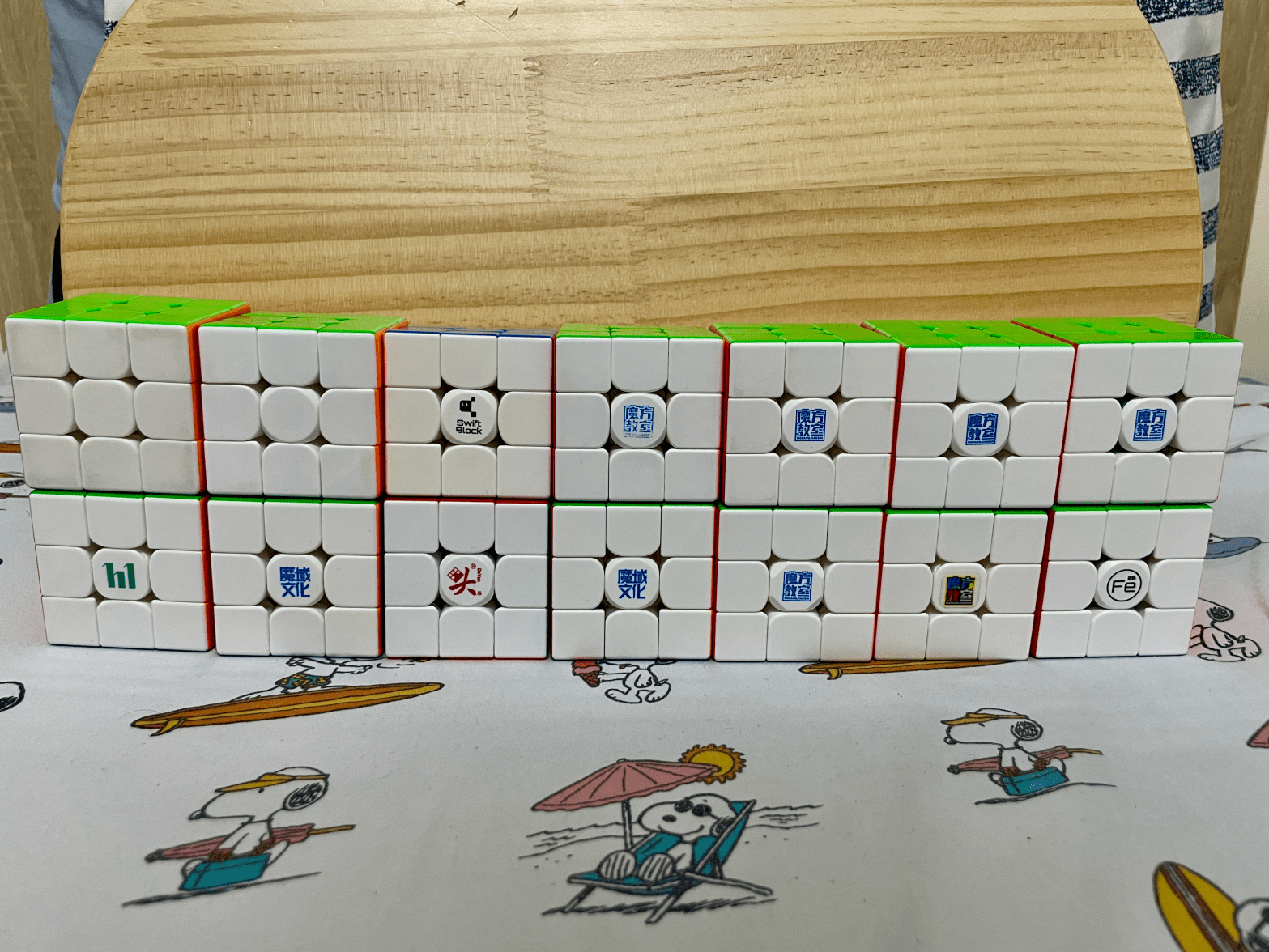
Speedrunning and Speedcubing: Eerily Similar and Surprisingly Different

You’ve probably been frustrated trying to play a video game. You’ve also probably been frustrated trying to solve a Rubik’s Cube. These frustrations can be quite similar. But what about doing both super fast?

If you’ve been reading my posts, you know I’ve talked about speedrunning before, specifically the history of the any% speedrun of the 1985 video game Super Mario Bros.

Yes, Niftski improved his own PB as of this article’s posting!

To refresh, a speedrun is a playthrough of a video game to satisfy an objective in the fastest time possible. Speedrunning has become much more than a hobby over the past decade, with events such as Games Done Quick and websites like Twitch to help popularize it. Any full recorded attempt that is done in the quickest time possible will be eligible for World Record (or WR for short) status, with speedrun.com functioning as the main body for verifying runs. The aforementioned website also acts as an archive for previous runs as well as a place for other speedrunners to submit their own personal bests (or PB for short).

Now, you might be wondering… what does speedrunning have to do with speedcubing? And what even IS speedcubing? Well…

Speedcubing refers specifically to solving a combination puzzle, most famously the Rubik’s Cube, in the fastest time possible. Unlike with speedrunning, where any personal best can be submitted for a world record, the World Cubing Association (WCA) only accepts attempts done at official competitions, a major difference between the two. This aspect I will discuss later, so let us discuss how speedcubing became a thing, where it is now, and where it can go, all while drawing parallels to speedrunning. Additionally, we will focus strictly on the 3x3x3 Rubik’s Cube, as other cubes of other sizes have their own histories.

Chapter 1: Genesis of the Rubik’s Cube

In 1970, Larry D. Nichols invented a 2x2x2 “puzzle with pieces rotatable in groups” held together by magnets, the predecessor to the modern Pocket Cube, the 2x2x2 variant of the Rubik’s Cube.

In the mid-1970s, Ernő Rubik, then part of the Department of Interior Design at the Academy of Applied Arts and Crafts in Budapest, sought to create a structure of cubes that could rotate independently but without the entire thing falling apart. Upon successfully creating such a structure, he had inadvertently created the puzzle that became known as the Rubik’s Cube, as the more he twisted, the colors became more scrambled, and he was unsure if this new problem could be solved. He would later show this to his students, leading to the misconception that he had invented the puzzle for his students as a teaching tool to understand 3D objects. Rubik would eventually apply for a patent for his “Magic Cube” on January 30, 1975, which would be granted later that year.

By the early 1980s, the puzzle took the world by storm. On June 5th, 1982, 19 of the fastest solvers gathered for the first ever Rubik’s Cube World Championship, where Rubik himself was a delegate. The fastest time at the competition was 22.95 seconds by Minh Thai of the United States, the first ever World Record. Eventually, the puzzle would fade in popularity, and no competitions were held for over two decades.

Despite this, it was during these first several years that methods to solving the cube developed. One such method is the Petrus method, developed by Lars Petrus of Sweden, which involves strong intuition and “block-building” and is popular for solving the cube in the fewest moves (it is also the method that I use as a casual solver). Petrus himself finished fourth overall in the competition in 1980. However, this method has largely faded amongst speedcubers in the modern day due to the predominance and efficiency of other methods, including one known as CFOP.

CFOP stands for Cross-F2L-OLL-PLL, where F2L stands for “First 2 Layers“, OLL stands for “Orient Last Layer“, and PLL stands for “Permute Last Layer“. This method is built upon the idea layer-building, where solvers must solve the cube one layer at a time, and layer-building has been a loose method that has been in use since the earliest days of the puzzle. CFOP stands over beginner methods in a multitude of ways: the F2L step solves two layers at once, while OLL and PLL can be completed with one algorithm each. Wait… what is an algorithm in the Rubik’s Cube sense?

Whereas “algorithm” usually means “a set of rules to be followed in calculations”, the term in a Rubik’s Cube sense refers to “a set of moves used to orient the cube a certain way“. The universal notation is noted above, where letters are used to let solvers know of which layer or face to turn. Any letter on its own tells the solver to turn its associated face clockwise as if they were looking directly at it. If the solver needs to turn the face counter-clockwise, a prime symbol (‘) is affixed to the letter, similar to how it is used in mathematics to denote the complement (or “opposite”) of a set (sometimes a lower case “i” is used for “inverted”, although this is generally frowned upon because lower case letters are used for more advanced notation). Turning a layer twice leads to a “2” being suffixed to a letter (ex “R2” tells a solver to turn the “Right” layer twice).

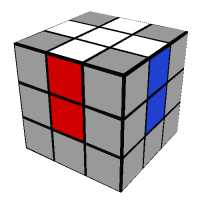
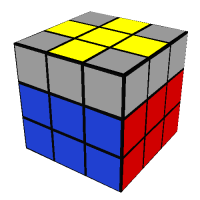
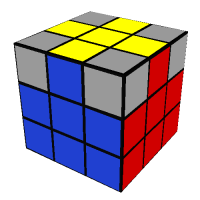
In essence, algorithms are used to manipulate the Rubik’s Cube into a favorable situation, as they are used to get to a certain scenario. To best illustrate this, let us discuss in essence how the beginner’s version of CFOP works, sometimes referred to as the “Dan Brown” method after the eponymous former vlogger who popularized it on YouTube (and an equally in-depth guide can be found here, and I will be sourcing some images from this website for this chapter): First, solvers must form a cross on one side in a way that the edge pieces of the cross are correctly placed. How anyone can know this is because the center pieces of every Rubik’s Cube are fixed and do not move, meaning everyone will know which layer correspond to which color. For simplicity, most beginners usually start by staying with one color for the cross when practicing (usually white or green). This step is largely intuitive, and while some of the moves are largely identical such that algorithms can technically be transcribed, they usually aren’t for simplicity.

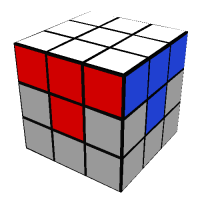
Upon forming the cross, solvers need to place the corners of the layer with the cross into position without breaking the cross. This step has numerous names for beginner’s context, either “The Corners” or “Solve First Layer” or “F2L1”. In this step, the first major algorithm appears, and it’s used to position the corners correctly. Additionally, the algorithm might be performed multiple times.

The next step (sometimes referred to as “Solve Second Layer” or “F2L2”) involves placing the four edges in the middle layer (or second layer) in place without breaking the first layer. By this point, the solved layer becomes the bottom or “Down” face (D). Again, algorithms are taught to beginners here to place the edge pieces properly.

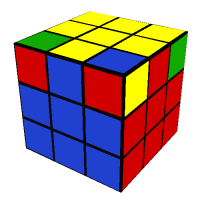
From this point forward, every step involves the last layer and solving it without sacrificing the previous two in the process. The first part involves getting a cross on the last year much like the first one, although it does not necessarily need to be oriented as properly like the first. Upon finishing the previous step, there will be four different scenarios. Should a cross already appear, this step is skipped, but the other three scenarios involve using one of two algorithms (one case requires both) to achieve a cross.

The next step involves actually getting the cross oriented correctly much like the first step, and the algorithm used here effectively “swaps” the positions of two adjacent edges.

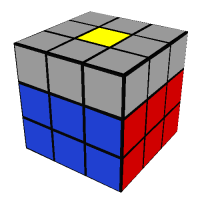
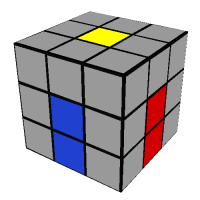
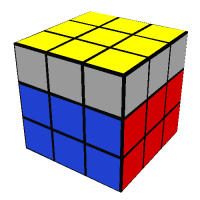
Afterwards, solvers need to get the corners in the correct place, and the algorithm used swaps the position of three corners in a counter-clockwise-fashion. How solvers can verify if corners are in the correct position is by using the centers as reference. For example…

In the above image, the corner with red, blue, and yellow is in its correct position (albeit not oriented or permuted properly), while the other three are not, meaning the algorithm is used to swap the positions of the other three corners.

Upon getting the corners to the correct positions, the last step requires getting the corners to be oriented/permuted properly, and the algorithm used is actually the same as the one to position the corners following the first cross. Upon the orienting/permuting the final corner, the cube will be solved!

Now why this long explanation of how to solve the cube? Well as mentioned before, CFOP shortens the previous steps significantly. First off, the cross is formed on the bottom as turning the cube as a whole wastes time. Secondly, F2L in CFOP immediately follows the cross and seeks to place both the corners and edges into their positions simultaneously as opposed to placing first the corners and then the edges. Then comes the magic.

Upon finishing F2L, there are 57 total cases that the cube will be in, and there exists at least one algorithm to get the cube to have the final face into one color for each case, a step, as mentioned before, known as OLL (if the final face is already one color after finishing F2L, you’ve technically arrived at Case 58 in which you proceed directly to the next step). There are then 21 cases the cube will be in following OLL (the “solved” case is an unofficial 22nd case and is rather uncommon after finishing OLL), and just like before, there is at least one algorithm for each case to solve the cube; the step known as PLL. The fact that upon finishing F2L, that only two algorithms separate a solver from finishing should go to show just how fast CFOP is. The initial algorithms for OLL and PLL were developed by Jessica Fridrich of Czechia, which is why CFOP is sometimes referred to as the Fridrich method.

Chapter 2: Genesis of Speedcubing

It wasn’t until 2003 when the World Cube Association (WCA) was founded by various online enthusiasts that kept the interest of speedcubing alive. Wishing to meet in person and compete, from August 23 to 24 in 2003, the WCA held the first competition in over two decades. Dan Knights of the United States broke the 20-second barrier with a time of 16.71, then Jess Bonde of Denmark broke it at the same competition with a time of 16.53. In 2004, Shotaro Makisumi of Japan shattered the record further with a time of 12.11. The record then went further down as time went on over the next few years. Here’s a timeline through February 24, 2007:

DateContestantCitizenshipEventTime
June 5, 1982Minh ThaiUnited StatesWorld Rubik’s Cube Championship 198222.95
August 23, 2003Dan KnightsUnited StatesWorld Rubik’s Cube Championship 200316.71
August 23, 2003Jess BondeUnited StatesWorld Rubik’s Cube Championship 200316.53
January 24, 2004Shotaro MakisumiJapanCaltech Winter Competition 200415.07
January 24, 2004Shotaro MakisumiJapanCaltech Winter Competition 200414.76
April 3, 2004Shotaro MakisumiJapanCaltech Spring Competition 200413.93
April 3, 2004Shotaro MakisumiJapanCaltech Spring Competition 200412.11
October 16, 2005Jean PonsFranceDutch Open 200511.75
January 14, 2006Leyan LoUnited StatesCaltech Winter Competition 200611.13
August 4, 2006Toby MaoUnited StatesUS Nationals 200610.48
February 24, 2007Edouard ChambonFranceBelgian Open 200710.36
Source

Before we continue, consider the fact that it was also during the mid-2000s that achieving high scores in video games and speedrunning regained interest amongst some of the general public. Yet another parallel between speedcubing and speedrunning: not only are their internal concepts similar, but their own histories and genesis were also similar.

Anyway, the first to solve a Rubik’s Cube under 10 seconds was Thibault Jacquinot of France, doing so with 9.86 seconds at the Spanish Open 2007 on May 5. Some believed that this would stand for a long time with this monumental feat, but Erik Akkersdijk of the Netherlands broke it at the Dutch Open five months later with a time of 9.77 seconds. Ron van Bruchem, one of the founders of the WCA, broke that about a month and a half later at the Dutch Championship with a time of 9.55. Chambon would take it back at the Murcia Open the following year with a time of 9.18. However…

Yu Nakajima broke the 9-second barrier with a time of 8.72 at the Kashiwa Open on May 5, exactly a year after Jacquinot broke the 10-second barrier. What made his feat so remarkable was that he achieved the same time TWICE, the second being in the final of the event.

However, this only stood for about three months.

In what many considered the greatest record at the time, Erik Akkersdijk yanked it back by shaving off over a second and a half with a final time of 7.08. This record became widely publicized and it stood for a remarkable 854 days. Until it was broken, this was the longest standing record since Minh Thai’s from 1982.

Chapter 3: Speedcubing takes off

If you recall anything about the Super Mario Bros any% speedrun, it’s that there were numerous moments when the category was thought to be dead. Indeed, Erik Akkersdijk’s 7.08 nearly represented a point when the World Record was just going to end there. However, as you can recall, practice runs do not count towards World Records, but they can show how fast they can be. The previous video I had shown on Yu Nakajima was a practice solve with a time of 6.57, which was technically FASTER than the record of 7.08. So if it was possible to do in practice, could it be done in competition?

By 2010, Feliks Zemdegs, a young speedcuber from Australia, was beginning his meteoric rise. He had set the World Record for an average of five solves on January 30, 2010 at 9.21 at the Melbourne Summer Open 2010, and in just over nine months, he broke the record for a single solve with 7.03 seconds at Melbourne Cube Day 2010. However, he wasn’t done that day: he broke the 7-second barrier in the same competition with a time of 6.77.

One of Feliks’s major advantages was his color neutrality, a strategy that dates as early as Lars Petrus in the 1980s, who used his method WITH color neutrality to reach the championship in 1982. This concept revolves around being able to solve the cube from any point and with little regard to starting color. Previously with CFOP, speedcubers would fix to one color for the cross (meaning they always made a cross of the same color) as it gave better results when beginning for F2L, as every speedcuber is given an inspection time to analyze where the pieces they need are and to plan their solve ahead of time. Indeed, prior to 2007, no CFOP user recommended color neutrality as a viable strategy. However, even casual solvers such as Dan Brown had recommended color neutrality as a way to solve faster. Indeed, Rowe Hessler’s success in 2008 is attributed to color neutrality, and then it was Feliks who propelled it even further.

Throughout 2011, Feliks proceeded to take his own records further. By the end of the year, 6.77 felt like nothing.

DateDateTime
January 29, 2011Melbourne Summer Open 20116.65
May 7, 2011Kubaroo Open 20116.65
May 7, 2011Kubaroo Open 20116.24
June 25, 2011Melbourne Winter Open 20116.18
June 25, 2011Melbourne Winter Open 20115.66

By the middle of 2011, Feliks had switched to using a cube manufactured by DaYan, a Chinese cube maker and one of many from China that had begun making cubes optimized for speedsolves (more of these companies have popped up since, including GAN, who now sponsor Feliks). Additionally, his 5.66 was another second-shattering record and one that again stood unmatched for nearly two years.

On March 2, 2013, Dutch speedcuber Mats Valk took the record with a time of 5.55 seconds. This one would stand for over two years. Then American speedcuber Collin Burns would take the record on April 25, 2015 at the Doylestown Spring 2015 with a time of 5.25 seconds. As remarkable as these breakthroughs were, something bigger was on the horizon.

On November 21, 2015 at the River Hill Fall 2015, Collin Burns managed a 5.21 on a bad scramble from the officials, then Keaton Ellis managed a 5.09 at the same competition. However, it was Lucas Etter who wound up in the books, shattering both times with a 4.90, the first ever solve in competition under 5 seconds. A new world record.

Afterwards, numerous speedcubers took the record in an all-out blitz over the next few years, and there were some familiar faces who took it back…

DateContestantCitizenshipEventTime
November 5, 2016Mats ValkNetherlandsJawa Timur Open 20164.74
December 11, 2016Feliks ZemdegsAustraliaPOPS Open 20164.73
September 2, 2017Patrick PonceUnited StatesRally In The Valley 20174.69
October 28, 2017SeungBeom ChoSouth KoreaChicaGhosts 20174.59
January 27, 2018Feliks ZemdegsAustraliaHobart Summer 20184.59
May 6, 2018Feliks ZemdegsAustraliaCube for Cambodia 20184.22
Source

Feliks’s 4.22 is his latest world record, as someone else bested him on November 24 that year…

Yusheng Du of China kind of just broke it open. His remarkable 3.47 remains the current world record. The four-second barrier had been broken. This solve was slightly controversial as the footage was only caught on a security camera at a rather awkward angle, but it has been analyzed and confirmed by numerous people in the community, including Phillip Lewicki and prominent YouTuber and speedcuber Dylan Wang (better known as J Perm). Regardless, this time has stood for an astonishing three years, longer than any previous record outside the first one by Minh Thai nearly 40 years ago.

Chapter 4: Future of the 3x3x3

You might be wondering once more if this time has even been bested or even come close in practice. The answer is YES, multiple times. In fact, there have been solves in practice under three seconds (THREE!!!). However, there had been some skepticism in the first several months over whether it was even possible following the new world record.

This is where I present to you some of the remarkable feats that speedcubers have accomplished since in practice, some of which include analyses:

Solving the 3x3x3 under four seconds, once considered a pipe-dream, has now been done numerous times in practice. There are also now at least four to have solved it in under three seconds (THREE!!!) in practice: Max Park, Fahmi Aulia Rachman, Leo Borromeo, and Ruihang Xu. Fahmi Aulia Rachman happens to hold the fastest in practice with a time of 2.62 (reconstruction here), and he did so using a rather uncommon but notable method for speedcubing known as the Roux method (named after its French founder Gilles Roux).

Regardless, it seems obvious that a time under three seconds can THEORETICALLY be achieved in competition given that personal bests have been achieved in practice, however, there are many factors that weigh against this. While many can attribute the remarkable advances in speedcubing to tricks and strategy, what can separate a good solve from a bad solve involves an infamous metric that can NEVER be quantified: luck.

Consider luck the speedcubing equivalent or parallel to RNG in speedrunning. Good RNG in a speedrun can keep a good speedrun alive as it does with “hands” in Super Mario Bros. 3 (a good explanation of what this means can be found here), while bad RNG can absolutely sink it. This can happen in speedcubing: a lucky solve can result in a skip in steps or just simple ease in the process of solving, and this can be potentially exploited during the inspection phase, as seen in Leo Borrameo’s 3.57 (his surprise exemplifies this).

Consider the fact that thus far, we have largely been discussing a single solve. As mentioned in the video by Wired, most speedcubers don’t even care much for the single solve, instead taking great care in the World Record average, which as mentioned before, is taken with an average of five solves (in reality, the best and worst times of the five are not considered and the remaining three are then averaged). Speedcubers consider the average a true test of skill. Even if you get a lucky solve, your average will reflect just how quickly you can usually solve the cube. Feliks himself has set the World Record for average more than anyone else, and his best average of 5.53 was the WR from November 10, 2019 (when he set it at Odd Day in Sydney 2019) until Ruihang Xu beat it at the Wuhan Open 2021 with an average of 5.48. Max Park of the United States broke this about five months later with an average of 5.32, then it was Tymon Kolasiński of Poland who took it down further at Cubers Eve Lubartów 2021 with an average of 5.09.

These are where the records stand today. Who will beat Yusheng Du in competition? Will someone average better than Tymon? Can anyone average under five seconds? Might I oblige with a statement from speedrunning, specifically the golden rule: the limits are never where we think they are.

The Very Best of Jerry Remy

I originally wrote a piece earlier this year that covered some of Jerry Remy’s best moments in the booth with Don Orsillo, but given that Jerry has sadly passed away recently, I think it was best to look back at some of Jerry’s best moments in the booth and outside of all time. I will not be providing any additional commentary this time because I want to let them speak for themselves.

…oops!

Another Jerry Remy?

The Grind

Jerry drops his notes

Remy reads his 2009 book on Wally

Drawing a line

Poncho Trouble

Hallion rings ’em up

The Window Incident

Bobbleheads

“GET OUT OF HERE!”

Denny Disco

Manny petting Tavarez

Grasshoppers

Jerry’s accent

Don’s New Lamp

Jerry loses a tooth

Leary and Clarke takeover

HERE COMES THE PIZZA

Air Guitar Remy

First Pitch

Rest In Peace, Jerry, for you will be missed, and Fenway Park truly will never be the same. We thank you for your years of service for the Boston Red Sox and for forever being a part of us. Peace and Love.

My Video Game History, Part 4: Finding Gems

2015 – Grand Theft Auto V

Not one… but three.

I consider this game to be a counterpart to Grand Theft Auto IV, and I mean this in a more personal way rather than like a general sense.

What I enjoy about GTA IV is the story. I care about the characters and find genuine joy from the interactions between them. With GTA V, the story is good but I don’t feel as much for the characters. They are memorable for sure but I don’t feel that I care as much. What keeps me from going back to GTA IV are some minor gameplay elements such as always having to do activities with friends and having to maintain the mandatory girlfriend relationships during the main story. I feel, that by extension, I can come back to GTA V a little more often because there’s less maintenance with the game that feels “necessary”. Additionally, there are a lot more gameplay elements that are more refined compared to where they were in IV.

As for the game itself, it’s still an enjoyable, satirical, over-the-top take on America’s excesses and reality. Franklin’s arc involves him trying to escape the hood and finding his own path, Michael’s arc focuses on him overcoming his past and trying to find fulfillment, and then there’s Trevor… just being Trevor. They also have their own unique deuteragonist for their arcs: Lamar being Franklin’s childhood friend who routinely gets himself in trouble, Dave Norton trying to keep Michael out of trouble after helping him lay low with the latter’s new identity, and Ron just trying to keep up with his unlikely friend and business partner. Again, there are interesting dynamics at play here with how their stories end up together.

I should mention the gameplay. Friend activites are still available to the player, but these are instead prompted by the player rather than the NPCs prompting them, a godsend to those who hated trying to go back to a safehouse to save up only to get a call about “wanting to shoot some pool”. There are also places to help refine skills in the game such as shooting ranges and flight school for those who might need help with handling the game’s weapons or the plethora of planes available for use. Driving also just seems more polished compared to how it was in IV, and even then, the driving in IV is VASTLY improved from the slippery feel in the GTA III era.

So again, I’m more likely to come back to this title than IV, although when I do depends on how much I want to engage with a story that, while interesting, doesn’t resonate as well for me.

2015 – The Last of Us Remastered

Breathtaking. Heart-wrenching. Everlasting.

This game blew me away.

When I started playing this game, I found great difficulty in trying to put the controller down. There was one point early on where my mom was asking me why I was still playing and to hurry it up because we were about to watch a movie on the TV.

I remember Sam recommending this to me and I heard rave reviews about it but I didn’t pick it up on PS3. I remember in the spring of senior year, Sam and my other suitemate Matt put together a list of games that I needed to play, and gave each one a “Kyle” ranking out of 5, with The Last of Us garnering a “2”. Boy, were they wrong on that rating.

That summer we went back to Taiwan again and my grandma told my dad that there was some lottery thing we won over something related to our bank account number or something and that some gaming thing was the prize. My dad said that we should at least look to see what it was and my brother had the honors of opening the cardboard box. Once he opened the covers and saw what was inside, his jaw dropped to the floor and he stood there in silence as his body began to shake. Right in front of him sitting in that box was another box containing a brand new PlayStation 4. We now had another console to add to our arsenal (and it kept the PS3 as the lone console we’ve actually bought, for the record).

When we began to look around for games over the next few months, my brother got Destiny and NBA 2K16 while I looked for Wolfenstein: The New Order (another FPS which I highly recommend) and the remastered version of The Last of Us based on Sam’s recommendation and I remember texting him about my purchase (he questioned the pricing, by the way). Regardless, as soon as I began to play, it began a revelation.

Never have I been so glued to a game with its immersive story and atmosphere. This game just grabs you and takes you into its universe. It’s dark, gritty, and depressing with its onset. But then as you go along, you’re given glimpses of light, hope, and most endearingly, love. This game can hit you like a ton of bricks. It’s so captivating with the characters and how the narrative can make you care for them. Joel and Ellie’s arc is an emotional roller-coaster but it’s so rewarding just to go through that experience. I really hope that anyone who doubts storytelling and presentation in video games thinking that they cannot compare to books or movies play this game. You will not be disappointed.

Then there’s the DLC content in Left Behind, which adds another layer to the story. I recommend that anyone who owns the remastered version play through the Summer and Fall chapters, and prior to engaging in the Winter chapter, go through Left Behind because it provides some additional context and adds a little something when going through that chapter in the snow.

My brother did wind up getting me a collector’s edition of The Last of Us II because of how much he knew I loved this game. But I told him that by that point, I knew of the potential downfalls with the new game and I still remain hesitant to even pick it up because of how much I’ve learned about what happens. I don’t want to get that Game of Thrones feeling (for the record, I never really watched the series and am just trying to make an analogy so that everyone understands my despair), but it’s going to be inevitable.

2016 – South Park: The Stick of Truth

Brad was all of us.

This game is the perfect licensed game.

I put so much into this game that I managed to get a Platinum trophy for this on PS3, and it will likely be my only Platinum trophy. This game perfectly captures the mood, feel, and tenor of South Park that it’s a must-play for fans of the show, largely thanks to Matt Stone and Trey Parker playing a major role in the game’s development.

If you’ve played any of the first two Paper Mario games, the battle system will feel familiar and easy to adapt to. The classes are also a lot of fun to toy around with. It got to the point that based on my playstyle with each class, I developed a spreadsheet to remind myself of which perks to get and which abilities to upgrade. In that same spreadsheet, I also began to note of all the collectibles (including ones that can be missed to prevent 100% completion). I went even further by listing the order of which collectibles are collected when as well as separating them by segment (Day 1, Day 2, Day 3, etc).

The partners in this game are also something. Butters is your loyal comrade and I always choose to side with the Humans when attacking the school to avoid fighting Butters. Kenny has his own unique niches as the princess. Jimmy wound up being the most useful when fighting Al Gore and his agents due to his ability to put enemies to sleep. Stan is an absolute bruiser who helps in the 2-on-1 boss encounters. Cartman is a fantastic glass cannon. Kyle’s Rally ability is also insanely overpowered.

Again, this game goes against the notion that licensed games are bad. Yes, most licensed games are garbage, but this one is an absolute gem. My only real complaint is that the level cap is too low. You can get to Level 15 a lot earlier than intended which can make later engagements kind of a joke. Additionally, I do think that the game’s length could have also been just slightly longer. But overall, I love this game a ton, especially as someone who loves the show.

2016 – Super Mario World: Return to Dinosaur Land

This got me started.

I forgot how I heard about this but this was the first real ROM hack I had played since Super Demo World by FuSoYa and Zero-G (the former being the creator of Lunar Magic, the most popular SMW level editor) and a good chunk of Anikiti’s Luigi’s Adventure (which, by the way, is total trash, just ask shovda).

As for the hack itself, I’d say it’s the hack every SMW player getting into ROM hacks play this first. It’s a great hack with fantastic level design that introduces the basic mechanics and gradually increases the difficulty. Some of the secret exits are also quite whimsical with how they’re found.

Two levels of note include Choco Peninsula 6 and Bowserland 6. The former’s second half involves hitting every ON/OFF switch to allow your platform to reach the goalpost that’s tricky but very fun to pull off. The latter, on the other hand, is a speed course where you have to dodge the rampant Bullet Bills and Banzai Bills and get to the goalpost within 100 game seconds.

Anyway, this game I think is a little more forgiving compared to the original SMW, and whichever order you play it in is up to you, but one cannot play one without the other, at least in my opinion.

Do check out my gameplay of this hack too. Here’s the link.

2016 – The Second Reality Project Reloaded

I remember seeing a TAS of this game and expressing a fair amount of interest. Then I decided to play the game for myself.

Here’s the thing though: at the time I got this, I had to play on ZSNES thanks to the ROM’s music being incompatible with most emulators and virtually all SNES hardware (that has changed apparently), so that was something. However, needless to say, the game starts out pretty mellow but is especially punishing and unforgiving that the average player will require save states and a guide (I used PinkKittyRose’s gameplay videos) to complete. It isn’t a Kaizo hack by any means, but it’s just very, very difficult.

Overall, I do think it’s worth a playthrough if you are curious, but it’s admittedly not for everyone and I do think that you will need patience to beat it, and even more patience without save states.

Do make note of the music in this hack. It’s largely self-composed while some of the other tracks are adapted from other games. FPI did a fantastic job. You can download it here.

2016 – Super Mario World 2: Yoshi’s Island

Not your average speedrun.

I first owned Yoshi’s Island DS and didn’t finish it (still haven’t and am very slow to do so because the game feels quite pedestrian).

So here’s the thing: I still have yet to get 100% in this game. I’ve gotten to 6-7, meaning two main levels along with all the bonus levels. That being said, I can safely say that this game is a blast to play.

I can tell a lot went into making this game. The graphics are colorful and the music dynamic. The folks in the video above also really dive into how much they appreciate the game. What I find interesting is that how one plays the game and their interaction with the controller is informative of how they like to play the game: Trihex seems more frantic while Carl seems more cool and collected.

Sometimes I’ll just jump into the game and replay all of Worlds 1 and 3 to rack up lives ahead of attempting new ones. There’s a lot to like about the level design and I think this game allows for a fun time. It’s a bright, fun game with a lot to offer.

2017 – Twitch Plays Pokémon: Anniversary Crystal

Uh-oh…

This is yet another game that I have yet to finish. In fact, it’s the first game that I began a playthrough to record footage for YouTube (which, by the way, remains unfinished). Regardless, this game is a must-play alongside Crystal Clear (which I have yet to play but only hear good things about), and are the must-play hacks for fans of Pokémon Crystal.

I don’t want to spoil too much on this game’s plot as I do with the video above, but I’ll leave it at this: there are a few quality-of-life things that the Twitch Plays Pokémon developers added from later generations that make this a joy to play. Also, there are also some minor graphical things they do that you might not notice at first glance and don’t really affect the gameplay but just add to the experience. For example, dampening the color of all sprites in caves or at night. Or maybe the additional sprites in the party screen.

Also, who wouldn’t pass up the opportunity to teach your Pikachu Surf for the Surfing Pikachu sprite?

2020 – Portal 1 + Portal 2

Expecting the song about cake?

This is here because I really don’t have anything to complain about with this game. There are really no flaws with both of the Portal games.

This was another game that Sam had recommended to me and I did wind up getting once I got Steam. Sam told me of Thanksgiving sales and I decided to get both of the Portal games then, but I sat on them for a long time. However, the pandemic certainly changed moods and I decided to play them and needless to say, I was pleasantly surprised and thoroughly impressed.

Here’s the thing, though: I had knowledge of the basics of how Portal works thanks to watching the Achievement Hunter people try to play Mari0, a flash game that combines Super Mario Bros. with a portal gun (even featuring Portal-style levels which I beat prior to playing Portal 1). Then there was the incomplete Two Saiyans Play Portal 2 playthrough where “Nappa” somehow manages to utter a serious “no”.

I mean in the end I still had no idea of what to expect for the puzzles in the game, so some I spent a great deal of time on, but I find the narrative to be quite interesting, and I do find the sequel to be better because of its story. Yes, the story is quite minimal and mysterious but that adds to the allure. There’s also the eternal wonder if a third Portal will ever come about (much like if there will ever be a Half-Life 3 as I hear), which I highly doubt.

If anyone’s interested in just simple platforming and puzzles, the Portal games are a must-play.

2020 – Clone Hero

Bad path.

So what happens when the rhythm gaming community decides to make their own game to port custom songs? Clone Hero happens. And boy am I glad I have this.

I first owned Rock Band stuff in 2018, but a problem remains in that I can’t get codes to port my RB1 and RB2 songs into RB3, let alone RB4 whenever I get that game. But with Clone Hero, I have all the songs from RB1 to RB3 along with Lego Rock Band, Rock Band Blitz, and a plethora of DLC songs. I think Clone Hero is a fine substitute for those who got into owning Rock Band merch late, especially since it’s community built meaning there will always be something out there for what you want.

Karaoke anyone?

2020 – Mario & Luigi: Superstar Saga

Say no more. It’s the best thing about this game.

I got a lot of recommendations to play this title. Spenser was probably the one who egged me to play this title the most, so I inevitably decided to play it last fall along with Super Mario RPG, which many believe to be the progenitor of all Mario RPG titles like the Mario & Luigi series and Paper Mario series.

In the end I enjoyed both Superstar Saga and SMRPG, but over the short time since I feel that the former is the superior title. Both are really good, but I find Superstar Saga to be the one I can go back to the most thanks to its whimsical plot and overall more engaging gameplay.

This boss fight, as well as the cutscenes that precede and proceed after it, are a microcosm of the game.

I don’t think a game has surprised me in unexpected, witty ways in this kind of fashion. The dialogue in this game is superb. Characters are so damn memorable. Bubbles is probably the most hilarious one-off character. Hermie with his lisp is quite the endearing fellow despite wanting to try to kill you. Jojora is that petulant brat who summons a monster “friend” to kill you. Popple is that funny, recurring mini-boss who never seems to get his way. Then there’s Fawful, who a lot of people like but I find utterly annoying. Sure, his lines are plays on bad translations (ex: I have fury!) and it’s a funny trait, but his overall character makes you want to punch him just so he can shut up. He’s goddamn annoying.

When I replayed the game about a month ago to acquire 100% item collection, I found it’s impossible on releases outside of Japan because of the change in drops, but I got even more appreciation with the game and was able to strategize far better than when I was playing it for the first time. I also feel that the Bowser’s Castle final dungeon is so much fun that I forcibly made a save file at the start of it just so that for fun, I can just play through it over and over again. Even so, I also briefly left the dungeon to unlock all Advanced Bros. Attacks before returning. It’s just that much fun!

I just think that it’s a shame that Nintendo is trying to steer away from games like this and Thousand Year Door. These games are what brought an audience and fanbase.

Also, anyone who doesn’t love that dance is an abomination that must be exterminated.

2020 – Among Us

Watching this live was something else.

I’ll keep it brief but this was one of the first games that I was able to play with my friends. We played this a ton in the fall last year and it gave us some solace as the world around us seemed to melt into oblivion. There was a lot of funny moments like Spenser accidentally revealing he vented (he was drunk), Megan being stuck with impostor curse, etc.

What’s funny is that I suck at lying as soon as I’m caught. This game doesn’t seem to be designed for me but I have actually had some notable wins as impostor. I’ve also had some really bad flubs as impostor. For example, I once got caught killing on a security camera, and in shock, I didn’t even speak as everyone voted me off. RIP

2021 – Mario’s Keytastrophe: Rebirth Edition

Puzzlin’ good in the neighborhood?

I’ve posted about this before, so I’ll keep it brief. Never in my mind did I think I’d find a game I’d be able to speedrun.

Here’s the deal: this hack is a lot of fun if you’re into puzzle levels. If you’ve played some SMW puzzle level or maybe a puzzle level in Mario Maker, this might be up your alley. There’s a lot of interesting vanilla and chocolate mechanics at play here for a really cool experience. The soundtrack is also phenomenal.

Again, you might’ve already read the breakdown of my speedrun already, so I’ve kept it brief. I love this ROM hack, and it’s my favorite of all time.

Conclusion

So, what do you think about this long talk about important games I’ve played? I’d greatly appreciate feedback on my posts! Thanks for reading, everyone.

My Video Game History, Part 3: Community Building

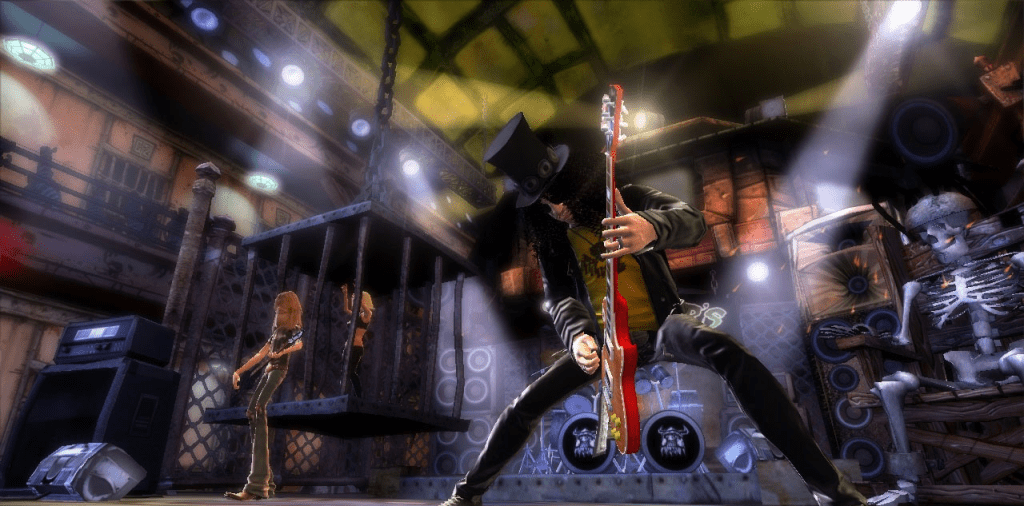
2007 – Guitar Hero III: Legends of Rock

The first time I really got to know the legend himself.

My brother and I actually played Guitar Hero II since our cousins owned it, although we would come to own this one and we both got the somewhat rarer Kramer guitar controllers that we proceeded to decorate with the provided stickers.

We also wound up playing this with friends, sometimes using our own console or on our friends’ since they owned it. Regardless, this was my first true rhythm gaming experience on my own, and I’d revisit it on occasion but put it down after a while until I started playing Rock Band in college (more on that later), and while I still have yet to beat the solo campaign on my own, I found that this game in particular remains one of the more difficult ones in the series but is at least a little more fair compared to the previous entry (which I also wound up playing a little more seriously in college).

Of course, the legend of TTFAF spawned from this game due to its initial inclusion as a bonus track, and I remember looking up the videos of Full Combos done by bots as well as fake videos of beating the song on expert (including one of a guy who jammed out on a tennis racket that I can’t find anymore). Obviously it’s been done to death by the most talented players these days, but one can’t help but marvel just how crazy people can be with chasing perfection (it happened with Jordan in Guitar Hero II as well).

2008 – Super Smash Bros. Brawl

Wario just loves hogging the screen.

I still look back at this game fondly because I was playing it nearly every Friday from my sophomore year of high school onward as I joined the newly-formed video game club. There were always the occasional tournaments but we had so much fun playing against each other for an hour during lunch (our meeting time).

What’s so good was that we’d learn each other’s playstyles and we even had our own lore with how we played. My friend Jon hated boxes because he once got smashed with one and lost a match because of it. My friend Bogart liked trolling us by playing on Spear Pillar while screaming, “IT’S JUST AN ILLUSION!!!” My friend Zac liked trolling us by selecting Summit so that we’d all get a chance to get eaten by the fish. Then there was me, the only one allowed to spam-camp.

…?

I think it’s necessary to talk about the “story” mode Subspace Emissary, because it was a nonsensical, fun way to enjoy the characters. I like going back to playing it just for funsies. Melee’s All-Star and Adventure modes are nostalgic for sure, but I have a special attachment to Subspace Emissary. There’s Fox and Falco coming to Diddy’s rescue, Snake’s disguise being found, as well as Link pointing to Ganondorf of the real danger (hinting that there’s more things to worry about). Again, I find so much enjoyment with this that it’s a great way to experience the game.

Then there’s Project M. That’s another Pandora’s Box.

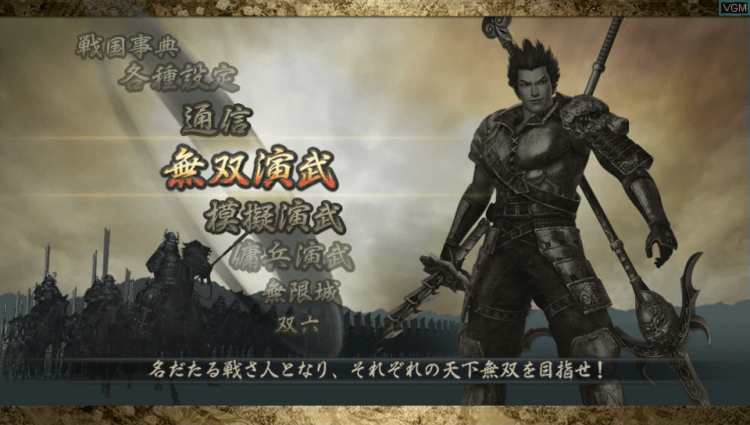
2008 – Sengoku Musou 2 Moushouden (Samurai Warriors 2: Xtreme Legends)

I can hear the music playing.

This game, similar to how Dynasty Warriors was for me, got me interested in Japanese history. Sure, I had some vague knowledge thanks to Onimusha 3 taking place during this same time period, but that covers a specific event: Samurai Warriors covers an entire period, the Warring States period (hinted at in the Japanese title, “Sengoku”).

It’s funny enough that I got introduced to the characters in the crossover title Musou Orochi (Warriors Orochi), but this title really got me hooked. Looking into the characters. Studying the battles. There was a lot of historical content just sitting there and I spent hours indulging myself.

Much like with how I made a project on the Coalition against Dong Zhuo during the Three Kingdoms period, I made a report on Tokugawa Ieyasu and the successes he made that allowed him to unify Japan and keep his legacy through his shogunate. I even impressed my teachers at Japanese school thanks to my knowledge of the battles and just general showing off of Kanji prowess.

As for the gameplay itself, it’s what the Warriors series does best – mindless killing but with a flare of strategy. There’s the characters that look like they destroy that end up fulfilling that when they level enemy troops. There’s also the characters that seem like joke ones but wind up being surprising tanks. I must reiterate that this series is not for everyone, but it’s one that means a lot to me.

There’s also an HD version for PS3 out there that I hope to acquire down the road. We didn’t have the Japanese copy of Samurai Warriors 2 so we couldn’t get to enjoy all of the content, so maybe when I have the remaster I can finally properly enjoy this awesome title.

2008 – Call of Duty 4: Modern Warfare

This is how you open a game.

I freaking love this game.

This is hands-down the best first-person shooter I’ve played and it’s not even close. I will be playing Halo down the road but I think what this game means to me is what a lot of my friends feel for Halo. I didn’t get to play Halo thanks to not owning an X-Box. I was also late to the PS3, but this was one of the first titles that I played and I was enamored.

The game’s plot to me is a perfect example of creating a nice, suspenseful, realistic story that hits the right story beats at the right time while also having a vague sense of self-awareness. It knows when to have fun and knows when to be serious.

I remember feeling genuine shock experiencing this part of the story for the first time. There was an underlying sense of terror. I think this moment was brilliantly done and excellently placed, and I gained even more appreciation from watching a video several years later by Noah Caldwell-Gervais (link here). My friend from college sent it to me since he knew of how much I enjoyed the sequel to this game and I remember we had discussed the Call of Duty series as a whole during our countless conversations. In the 2-hour long video, Caldwell-Gervais talks about the single-player campaigns of the CoD series from the inaugural entry to Advanced Warfare, analyzing the story beats and his own general thoughts. On Modern Warfare, he spends great length talking about the climactic moment in Shock and Awe and the general impact it had, and I’ll give a general summary here. Consider that this game was released in 2007 in the heat of the War in Iraq. Anti-war sentiment had been growing. Our troops were fighting in the Middle East in a war that seemed pointless (and one that was also completely unlawful and illegal). Then consider this game, which takes place in the near future in a near-identical location, and this happens. We thought we were doing good but we were uniformed and consequently fell into a trap. It really struck a chord with audiences, myself included.

As for additional material, I love playing the Arcade Mode as it’s a unique way to experience the single-player campaign. It’s interesting that some of the levels are designed that achieving high scores is virtually impossible, while others allow for scoring fests. And then there’s the level “Heat” where completing the bonus streak is so routine that the score for that level alone is incredibly inflated. It’s absolute mayhem.

Here’s another thing: I didn’t really know much about PlayStation Online until late 2010, maybe, and by then I had already moved on from this game, so I only came back to this one in late 2015 or so, possibly early 2016 to see what the online multiplayer was like. I remember playing it once and feeling so lost that I decided it wasn’t for me. Once I formally revisited the online multiplayer, I found it so gosh darn charming for its inherent simplicity. No choices for killstreaks: everyone gets the same ones. Grenade indicators are a symbol of death. Flashbangs are a mystery for the user. Last Stand still stinks. The matchmaking system sucks. Teams are incredibly unbalanced. It also doesn’t help that I found that I am the most skilled with this multiplayer compared to the ones in other CoD games. It’s an interesting love-hate relationship that I can only play it in bursts.

After much consideration, this game became my favorite much like many other fans. My thoughts on the CoD series as a whole also changed thanks to that video plus my own changing experiences: CoD 4 was lightning in a bottle. It created a high for the series such that Activision has been chasing it but has yet to even reach. Sure, sales have gone up, but actual audience ratings have declined since, most notably beginning with the eighth title (Modern Warfare 3). No game in the series will ever be as polished as this one. None will ever be well-received by critics AND audiences alike.

2009 – Grand Theft Auto IV

The best ringtone. Fight me.

I don’t think I’ve played a Grand Theft Auto game with a story as engaging as this one’s.

My first experience with this game came from my brother’s friend who introduced us to Star Wars: Battlefront (by this point his dad and step-mom had become close family friends so we saw each other rather often), and he showed us the first moments of Niko Bellic in Liberty City. Was it as ridiculous as Liberty City Stories? Possibly more. In the end, the story present is surprisingly well-crafted on its own and especially so when combined with the expansion games The Lost and Damned and The Ballad of Gay Tony.

Is it annoying to be in the middle of driving to a mission only to be called for an activity? Yes. That’s why I don’t come back to this game often. But even then, it’s worth sucking it up just to experience a fun story. Niko coming to terms with his thirst for revenge. Roman vowing to be better and eventually enjoying success. Little Jacob being that reliable friend that everyone wishes for. Dwayne learning that he should try to enjoy his second chance. I just love these characters!

YELLOW CAR

2009 – Golden Sun + Golden Sun: The Lost Age

A tale of mighty heroes and heroines.

I remember my cousins playing this title and knowing a few things about it, like how the end boss of the first game is a nightmare. Then I started watching videos and I wound up finding general enjoyment. It’s gotten to a point where I know what my final arsenal is and what my overall path is as I go through BOTH games.

Up until recently, I didn’t really think of these games as “top” games. Then I recently played through these two games again and I came to realize just how good these games truly were. I recalled how I was always recommending them to friends and was often lumping praise. I always liked these games a lot and didn’t have much criticism aside from the long cutscenes with long dialogue, but even then those exchanges between characters are so engaging because I came to care about them with how brilliantly crafted the story is. I regard these games as a two-fold because Lost Age’s beginning coincides with the end of Golden Sun, and the stories together create one giant arc that is so well put together. I don’t want to spoil too much, but there is a major plot twist that is interestingly hinted at throughout Lost Age. Also, I do recommend that while Lost Age has double the content in my opinion, it’s necessary to play Golden Sun first.

The gameplay itself is very engaging for those who are accustomed to playing turn-based RPGs like Final Fantasy (which I ironically have not played any title from). A lot can determine your party’s turn in battle, and the different classes the characters can switch to offer a different way to play the game. I think the weapon forging in Lost Age opened a TON of customization options and it’s something I didn’t really appreciate until my recent replay of the game.

Gameplay by yours truly.

I think my biggest praise is to both the graphics and score. This game is beautiful on the Game Boy Advance, with many of the animations being stellar quality for a handheld console. The music is also on another level, and it may be my favorite video game score ever. The Venus Lighthouse music is a fan-favorite, as is the theme for the Elemental Stars. An underrated track is the town theme for Imil (post-Mercury Lighthouse) and Suhalla, which sets up a nice, cozy atmosphere.

When will Golden Sun rise again?

2009 – Call of Duty: Modern Warfare 2

The best victory message in the game.

I remember the hype surrounding this game. Then we got the game and promptly were having fun.

This is the first (and thus far only) game in the series where I beat the Veteran campaign (highest difficulty). I remember feeling genuine satisfaction from it. Then I did so again in college for the video game club. I remember my friends watching me go through it and they were impressed that I pulled it off. I even went for all the laptops (and I still remember where a vast majority of them are).

Ramirez, Do Everything! | Know Your Meme
They just loved barking at poor James Ramirez while they did ABSOLUTELY NOTHING.

Does the story hold up? Mostly. Again, the most controversial mission (No Russian) is part of why it’s shaky. Seeing an airport massacre where civilians are razed down in machine gun fire? Unsettling. Being able to participate in it? …honestly distasteful. Caldwell-Gervais put it as a poorly-conceived level with a serious point. There are for sure definite consequences of the events in the level that set up the spiral in the campaign, but simply skipping over this mission (which was patched in shortly after release) is the way to go. There’s no need to play it and it’s best thought of as a noticeable blip in an otherwise good follow-up.

It’s always fun to have a bunch of crates on the map.

This was also the game that I played online multiplayer for the first time. I got pretty good at a few points, even pulling off the “Tactical Nuke” twice, both without the Hardline perk. I even remember whiteboy7thst’s “World’s Fastest Nuke” video. I’ve largely resigned myself since those days to playing more or less for fun and not getting caught up in the competition, especially since aim-bots are still a problem and OMA noob-tubers being the dirtiest players to ever walk the face of the MW2 multiplayer scene (exception given to whiteboy for his record). But those E-drops are so fun to pull off. IT’S RAINING CRATES!

2010 – Plants vs. Zombies

NOOOOOOOOO!!!

I initially laughed off this game. I was first exposed to it doing an internship at City of Hope National Medical Center where one of my uncles was an oncologist at the time. My fellow interns were playing and I was like, “there’s no way I’ll get into this” since they were all addicted. Then they gave it to me and I got suckered in.

I remember developing strategies and looking them up online just so I could set personal records for Survival: Endless. There were the minigames that were absolutely challenging. I have a lot of fun memories of this game. The game itself is incredibly charming for a tower defense game with the adorable designs as well as the corny, cringy puns. The Squash literally squashes zombies. The Wall-nut acts as a wall to stall zombies. The Cherry Bomb is an exploding cherry bunch. The Jalapeno is an exploding chili pepper. The Blover blows fog away.

Thriller.

I should also mention that I still get a laugh over owning an older version of this game that has the original design of the Dancing Zombie. It should come as no surprise as to what the inspiration was, and the estate of that inspiration apparently complained such that a redesign was necessary despite the original one being present before June 25, 2009. Funny how the almanac entry reads, “Any resemblance between Dancing Zombie and persons living or dead is purely coincidental.” Even more so, it enters the lawn moonwalking.

2010 – Call of Duty: Black Ops

Who doesn’t love Gary Oldman?

Dang. This game is just so gosh darn ridiculous. From the opening of the campaign, you knew you were in for a ride as you’re strapped in an electric chair that could be use- wait… actually used to torture your player character. Yikes! There was an inherent tone with the campaign in that it indulged on its violence: overplaying it for the sake of hamming it up. What was most important, though, was that there was a sense that it knew how dumb it was.

Much like the previous title I did play the online multiplayer. There was also a time where I was routinely mowing down opponents and getting high killstreaks. But that time has since passed because I came to realize that the mechanics are super technical and that it is a massive time investment to master them. Once you are out of practice, your skills will atrophy and it will take another lifetime just to get remotely close to where you were. What doesn’t help is that god-mode players will show up to ruin everyone’s fun, which is why I don’t really touch it anymore.

Then there’s the Zombies mode. This was probably my gateway to YouTube’s video game content. I watched so many videos of channels playing the maps doing various high round challenges and solving the easter eggs, with NGTZombies being my #1 channel for Zombies content (I originally watched from the mother channel NextGenTactics before NGTZombies was formed). I gradually learned the meta from the countless videos I watched and putting it into practice, but then I eventually developed my own separate strategies to adapt to my playstyle. I’ve spent countless hours just hopping on PSN and just playing round after round with random players. It’s gotten to a point where most often I end up with the most points scored when all of us die.

This game is now a decade old and I’m starting to feel old. But damn do I still love it.

THE NUMBERS, MASON! WHAT DO THEY MEAN?!

2011 – Rock Band 3

Not me playing but I enjoy their videos to this day. BEER (I don’t even drink).

This game allowed me to make lifelong friends, no joke.

I remember a short clip of my cousin playing Rock Band 1 and that was my first memory of the series. Then she and her sister (the same cousins whom we grew up with) got Rock Band 2 for the Wii and we played it a couple times when we’d visit. Then I got to college and I found myself playing Rock Band 3 at the video game club (officially the Game Development Club, or GDC). I went back every Saturday for Saturday Night Gaming (which all of us called “SNG” for short) just to play for a bit, and eventually, I would stay for the whole night and aid in the clean-up to store the equipment back in the office. And then I’d join the events board to help plan events. I was spending more time with the admins. We’d play Cards Against Humanity after midnight. There was also the planning for “Costume! Dance! Party!” for every Saturday night the week of Halloween where I was on ticket duty every year (starting sophomore year). The after party for that was a viewing of the Rocky Horror Picture Show. These interactions have blossomed into relationships that have left a definite mark on me. I had friends in high school for sure, but the friends I made at GDC form a core for me and are the first group that I’d consider “close”. It’s gotten to a point where I’d attend vacations with them on occasion. I’ve also seen two of my really good friends, Spenser and Megan, get engaged and I attended the engagement party. I was slated to attend their wedding. Then the pandemic hit, and while they have since had a smaller ceremony, I do look forward to the bigger one because I’m really happy for them and wish the best for them.

As for Rock Band meta, I walked into college being able to play Guitar on Medium difficulty with a flare of Hard. By the time I graduated, I was amongst the club’s best guitarists/bassists, routinely playing Expert difficulty. Sophomore year was where I felt I got the most growth thanks to completing a streak of SNG’s with at least one FC on Expert (most often on bass). Sure, by the time junior year rolled around, the streak broke, but I was happy that it was over because it meant I could just play and have fun while still developing my skill.

We also developed our own non-written “rules”. After discovering it by accident, one of my close friends Sam (who is, by the way, the friend who showed me the video by Caldwell-Gervais) would do dolphin cries during Rock Lobster (although we did not choose the song too often because it was meant to surprise people as it did me). No one was really allowed to play TTFAF (Sam would take a break and leave the room since he hated the song). We’d also deliberately scroll over all the Green Day songs thanks to it taking up a significant chunk of our already ginormous list of songs. If we wanted to piss off Spenser, we’d play Jessie’s Girl. Spenser would also sing the “doo-doo-doo” parts in Hungry Like the Wolf at an obnoxiously high pitch during the rare occasions we’d select it. When playing Don’t Get Fooled Again, I’d do Pete Townshend’s windmill motion when strumming long notes, and then after finishing the song, I’d wave the guitar controller as if to smash it to pieces like Townshend would ACTUALLY do to most of his guitars during live performances. There was also Killing in the Name, where we’d yell, “MOTHER!!!” in a gyst to the censors present in the Rock Band series despite rapping the rest of the song uncensored.

Ah, the Legend of Gaybraham.

Most importantly, though, we’d also start ending every night with Gay Bar by Electric Six, which led to the saying, “SNG goes from 7 (PM) to Gay Bar”, which would also lead to the CDP saying, “CDP (Costume! Dance! Party!) goes from 7 to Time Warp (the song from the Rocky Horror Picture Show)”. Eventually when we got BEER!! by Psychostick, and we’d incorporate as the penultimate song for every SNG.

Other traditions also spawned from things like this. There was playing Whip It by Devo and then following it up immediately by Jerk it Out by The Caesars, as Chuck, one of my other friends in the club, would mention that the order was necessary because the other way around, it’s messy (LOL). Sometimes we’d also preface the two songs with Business Time by Flight of the Conchords to really drive home the theme. Oh, how mature we were.

On the last SNG of my freshman year, the Rock Band room was unusually barren, and with just enough people to sustain a band, Spenser and I along with two others decided to just randomly play all of the hard songs with a near-failing drum set, a guitar controller for bass, and a keyboard for the guitar. All with No-Fail Mode OFF (we usually had it on so people could enjoy playing). One of the guys dubbed the playlist as “OOOOOOOOOOHIO” (the spelling could be a little off). This memory led to Sam (who was NOT present for OOOOOOOOOOHIO), Spenser, and I developing a sequel playlist “OHIO 2” for the final SNG of our senior year that was actually “do-able”. We nearly failed multiple times. I barely kept the band alive at the very end of Peace Sells. In Constant Motion, I deliberately held onto overdrive so I could save Spenser after the solo. After running to the hills, we could just laugh it all off by ending it by walking on sunshine.

Our group also had an oddball fascination with one of the available characters in the game, Moosejaw Boudreau. For whatever reason, we thought of some hair-brained idea of “cloning” him, i.e. making custom characters that look identical to Moosejaw. By the time we actually got around to doing it, we had the necessary wardrobe outfits to make it happen. First, however, we needed to create the eventual names of the new “clones”. The first was quite easy: Jawmoose. The next two, however, took a little longer. Matt, a suitemate of myself and Sam, came up with the third one: Joosemaw. Sam would come up with the final one: “Maasejow”, which he dubbed as being the “Scandinavian” cousin. Thus, we had our band of Boudreaus: Moosejaw, Jawmoose, Joosemaw, and Maasejow, the Scandinavian cousin. LOL.

Playing Rock Band every weekend led me to getting a Squier J Bass in January 2014. I knew how to play piano thanks to playing about 4 years with a tutor, then I picked up the Yangqin (Chinese Dulcimer) for seven years with another tutor. This time with the bass, I’ve been learning how to play various songs on my own. Sure, I had learned a bit of Guitar in 8th grade (which affects my playstyle as I am exclusively a pick-player), although I didn’t really know how to read anything for bass when I first picked it up. I don’t expect to compose anything, but I do wish to learn how to play a majority of the songs that I was playing those Saturday nights. I’d say I’m most proud of picking up Five Magics by Megadeth (for the most part), as it’s now my favorite metal song ever.

There’s no denying how much of an impact this game has had on my life. There’s no doubt I wouldn’t be here without it.

2012 – Musou Orochi Z

My first exposure to Koei’s sneakiness

I mentioned Musou Orochi earlier and I found out on this title because it combined that game with its direct sequel and made them prettier since both were on PS2 and this was a PS3 title. I liked Musou Orochi a fair amount, but upon playing this title, I really wondered why they didn’t just release THIS game in the first place.

A major complaint I remember about Musou Orochi: Maou Sairin (Warriors Orochi 2) was the game’s absurdly short length. When I played the game’s story mode, I understood why. Even the original’s story was pretty short. This opened my eyes to Koei’s questionable marketing and pricing of its titles.

I will say, though, I played this quite a bit in college and I do enjoy it. I even devised parties to tackle the story modes. I’ll visit it on occasion since it does break up what I’m usually playing anyway.

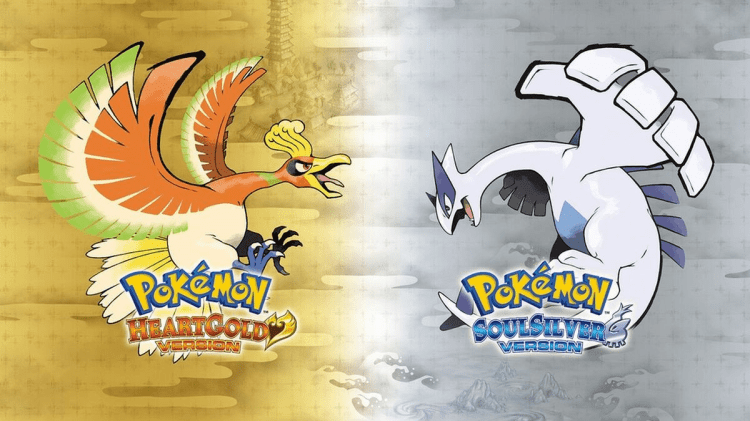
2012 – Pokémon: Heart Gold Version/Pokémon Soul Silver Version

My mouth dropped when I found out they were releasing these.

Because of how much Gen II Pokémon had an impact on me, I knew I had to pick up the remakes when they were announced.

It’s safe to say that I really enjoyed them and find them to be the best remakes that I have played. I did eventually get to Fire Red and Leaf Green on emulator and find them to be competent, these ones just mean a little more to me.

The new takes on the tracks are stunning. The main Kanto route theme sounds so bright. The contrast between Ecruteak and Cianwood’s themes is fascinating even though they were the same in the original games. Then there’s the new track that plays when the Kimono Girls summon the legendary birds. SO. F***ING. GOOD.

Gameplay wise they also cleaned up the speed even more from Platinum (which I played on emulator). To me, this was peak Gen IV. Battles were also engaging and offered a fair challenge. Additionally, because of its status as a remake, old battles now had a new take and I had an appreciation for it.

Overall, just really solid stuff here.

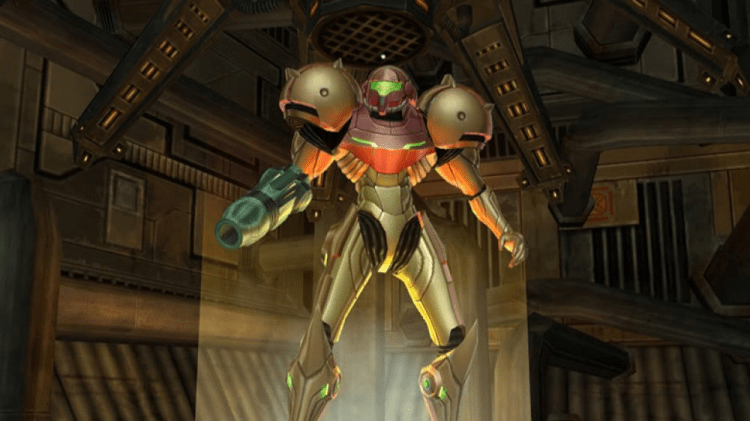
2014 – Metroid Prime

Badass.

I still find it crazy that it took until senior year of college for me to play this legendary title.

Because my suitemates all brought various consoles and games, I found this game in that stash of sorts and I decided to just pick this up because I remember seeing the title. Sam, who was among my suitemates, urged me to play it. Slowly but surely I began to play through the game and on occasion Sam would watch. In the opening sequence on the Space Pirate frigate, I accidentally backed myself into an elevator I just rode trying to lock onto a missile turret (I hated those things) that just landed a hit on me and Sam laughed his head off.

Needless to say, I found the experience to be incredibly immersive. There’s very little plot that’s just shoved in your face, rather the exploration of the game’s areas leads you to hints of what’s actually going on. This is very much a “throw the player in with next-to-nothing and see them figure it out”. I actually find that to be a charming aspect of this game. Usually I like a lot of plot-driven games, but there isn’t a lot in actuality with Metroid Prime, and it makes for quite the unique adventures.

The game’s mechanics took a little getting used to but I figured them out eventually. There was also a gradual challenge that I appreciated. With every new tool, a newer foe would come along for you to test it on. The bosses were also incredibly challenging, such that aside from the Parasite Queen intro boss, it always took me three tries to win. Omega Pirate stands out to me because most often I’d get frustrated with losing a boss fight, but with this one I found a lot of fun even while failing. Funnily enough, that rule-of-thumb for three tries on every boss largely stood true when I played Zero Mission the summer after I graduated from college (the exceptions being Ridley, whom I one-shot, and Mecha Ridley, whom it took five or six tries).

Breathtaking, literally.

The game’s score blew me away. I found the music for Magmoor Caverns to be deep, dark, and intense to match the mood of the area. The music for Phendrana Drifts is nice and cool while its variation in Phendrana Depths is my preferred one. Then there’s the crashed space frigate. I remember going through the area and coming to recognize it was the introductory area, just underwater, but once the music started playing, I was hooked. I still love listening to this track on occasion and just allow my mind to blank. It’s so soothing and calming to the soul.

If I could ever play this title again, I’d do it in a heartbeat.

My Video Game History, Part 2: Branching Out

Now we’re getting into branching off of handheld games for the most part and onto console gaming now as by this time, we owned one of the then-current generation (specifically, a GameCube). Then it came to branching off of Nintendo and into Sony with the PlayStation 2. Enjoy!

2004 – Mario Kart: Double-Dash

This game is dumb. And I love it.

I found out about this game with my brother when we played the demo at the fye (remember that store?) at the Natick Mall before it became the Natick Collection, and boy we were laughing our asses off when we were racing down the Mario Circuit track. We persuaded our mom (who was with us) to get it, and at some point we did end up getting it. What happened afterwards was another opening of Pandora’s Box where we played this game to death with friends and family whenever the occasion arose.

When I played this as a young kid/teen, we were often just playing for fun and didn’t really know of unlocking more characters, karts, and tracks. I had an idea they existed thanks to reading the Prima guide at various Game Stops and E.B. games stores, but it wasn’t until I had more knowledge of how to use the internet to find game strategies that I knew there was unlockable content. Until then, it was racing on the same tracks and bombing everyone in Bob-omb Blast.

This was cool to get.

Eventually I did manage to get everything in the game, and the process was honestly frustrating, as by the time I was grinding for it, I knew about the game’s questionable RNG thanks to playing Mario Kart Wii by that point (the most notorious Mario Kart game for its RNG). Also around this time, I was in college and my video game club threw around an idea for a tournament where entrants had to mimic the switching of the racers as they swapped in the game. Predictably, that never materialized.

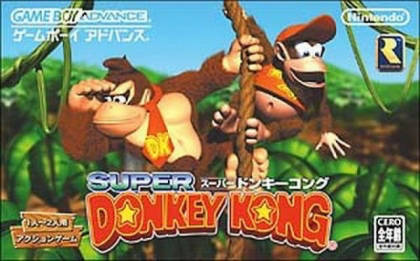
2004 – Donkey Kong Country (GBA)

Yea, this is how I knew this game at first.

I’ve played this game a lot as well, and it came in our laps after my great uncle (who also had a knack for video games) gifted it to us. It’s funny enough that we also got the Japanese port, so my brother and I often referred to this as Super Donkey Kong for a while.

Going for the 101% completion rate is certainly a thing. That bonus room in Oil Drum Alley? How could you find it without a guide? What about those BS temple levels? Trying to complete Candy Kong’s dance tasks perfectly? Ugh. Regardless, the DK Attack mode was another challenge altogether, and one I plan on investing more time into. Speedrun? Could be a stretch.

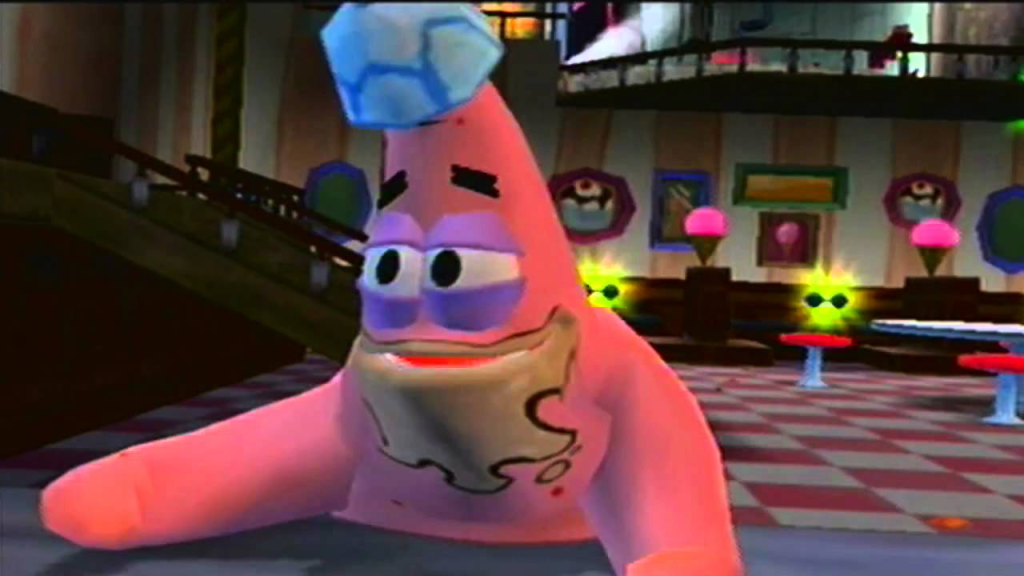
2004 – The SpongeBob SquarePants Movie video game

As soon as I see screenshots of this level, the music starts playing in my head.

I feel it’s necessary to mention this one because it’s one of the few licensed games I’ve played, and it’s one that’s ACTUALLY good.

We played plenty of this game when we first got it, but we never beat it. I did eventually during my senior year of college, and I’ve come to recognize there are some major flaws. For example, the need to acquire tokens to play new levels, forcing the player to replay levels to acquire hidden tokens. Or maybe the punishing difficulty towards the end of the game. Even then, the game still has the charm of the show.

Spongebob and Patrick’s attacks in the game harken to their personalities/interests in the show: Spongebob has his karate gloves. Patrick’s portliness is used for his slam attack, etc. . They also have their own challenges: Patrick has the Floating Block Challenge, for example, while Spongebob has the Spongeball Challenge.

Might I also mention the really good tracks in this game. The music is really good in this game. The music for slide levels is a banger. The Disco Star track is so dang catchy but it’s too short. Bubble Blowing Baby Hunt is just other-worldly.

2004 – Paper Mario: The Thousand-Year Door

It’s always a joy to see this demon, even though he doesn’t seem that way

Oh god, do I love this game.

I remember playing this to a point, then coming back to it, watching Chuggaaconroy’s videos, and trying to play the game but doing so terribly. Then there was a point where I was playing the game again, doing another playthrough, using a guide, and then actually beating it. Then I went to my old file and beat it. And both times, I also vanquished the Pit of 100 Trials first try. So many memories. Characters! A plot! Game mechanics!

I love these guys.

Goombella? Spunky. Koops? Adorkable. Flurrie? Fabulous. Yoshi Kid? Awesome. Vivian? Best. Bobbery? Reliable. Ms. Mowz? Sassy. Oh, and I’m not joking when I say “best”. Her story is really something. A trial in self-confidence. The original plot, as you may or may not be aware, has Vivian as transgender, and this was written out in some localizations (including in the US, unsurprisingly), although I don’t feel the morals were really lost. I feel the “censored” version still works well, and the original one adds another dimension to it (and it also makes some of the underlying morals all the more sense). Outside the plot, she also proves to be the best partner in the game, although each partner has their own unique and reliable use.

Villains? So funny. The unique laughs of the X-Naut commanders, Bowser always getting screwed over, the dubbing of the Great Gonzalez (a carryover of the original, funnily enough), Beldam eating her words, Cortez proving to actually being an ally, etc.

Combat? Fun and interactive. Easy to pick up, gradual difficulty towards mastery.

Music? So. Many. BANGERS. The Sewers. Battling the dragons. And that track in the X-Naut Fortress. It’s all audible chocolate.

So yea. I love this game to death.

2005 – Onimusha 3: Demon Siege

A handsome devil. And a total badass.

This was my first venture into hack-and-slash, and unsurprisingly, this was also one that my dad first played.

I didn’t really think of mentioning this game at first, but I’ve realized it’s one that is quite important to take note of. For one, this game was the first rated-M game I had any real exposure to and it’s quite brutal even for a PS2 title. The opening movie that’s on the game disc really showcases the violence level that Onimusha games touch upon (at least on viewing, because this is the only title I’ve played).

Of course, much like many games I used to play, I was exposed to the game’s “easy mode”, although it was through my dad: while there is a boss at the end of the first level, I consider that one to be more of an introductory boss, as the one at the end of the second level is truly a ferocious one for new players who have no idea what they’re doing, and the game’s easy mode unlocks upon two deaths in the same level (most often two deaths against the same boss). Naturally my dad undertook this and not long after, we bought the official guide that Brady Games published (which we still own, might I mention, and I one I used often). Having read through the book and watching my dad play through the first third of the game, I knew what to expect so I began to grind out the game’s equivalence to currency or experience to enhance my weapons to make the second boss a little easier.

Satisfying to pull off, but simultaneously incredibly difficult

Obviously my knowledge of the game and its mechanics have improved drastically as I largely don’t need a guide aside from the infamous gas chamber puzzle, although there are times in which the game is quite challenging. Also, I still have yet to unlock all of the game’s content, and I hope to do so at some point. The process of unlocking the “ultimate mode” was challenging as the minigame that unlocks it is quite difficult. Additionally, unlocking the Black Vest is one that remains quite difficult to do since it requires completing of the “Critical” training mode, and if anyone knows anything about Criticals/Issens in Onimusha, they’re difficult to pull off unless you’re ultra-skilled, which I don’t think I ever will be.

I’d also like to highlight the voice acting in this title as well, because I’ll be honest – the English one is quite tacky and sometimes just flat-out bad. If Capcom ever decides to remaster this title (which they did with the first game, and I hope they do remaster all four main titles), I hope there’s an option to hear the Japanese audio, because I’ve seen gameplay with it and it’s a lot better. Do check out this video if you’re either into the series and/or have played this title with the English audio, because it’s the game being played with the best skill. Also, who doesn’t love Kaneshiro Takeshi?

2005 – Super Mario 64 DS

I still wonder why Wario got added to augment the power-up forms.

I played the original version of this on N64, but that was at friends’ homes and in very limited capacity. When I saw a classmate play the minigames and then played some of the demos at target, I somehow managed to get this one, but interestingly, my copy was used so it already had 36 stars acquired. I eventually began to learn more about the game as I played on, and eventually I was able to acquire all 150. I have since played files from scratch, including one where up until the final course (Bowser in the Sky), I didn’t quit the game and simply closed the lid on my Nintendo DSi LL (while charging whenever necessary) to see how many lives I could collect. I also developed a path to acquire stars in a specific order, as well as completing the main courses in order. Fun times!

The thing is, I spent plenty of time just remembering how the courses work to gain mastery of the game, and I also spilled a ton of downtime just playing the mini-games. They’re a great time-waster! The Luigi’s Casino games are mindless fun, as are the random puzzle games where you wonder why you made a stupid move. It also doesn’t help that some are “endless” where at some point you kind of just get tired and quit like with “Wanted!” (It’s so funny that Luigi is most often the one you have to look for in that game).

I do have to mention that I did end up playing the original game on N64 seriously during my senior year of college (more on that later), although by the time I got to Tick-Tock Clock (deep in the game, for those unfamiliar), I had enough. While I feel that there are plenty of people who prefer the movement on N64 due to the full 2D capabilites an analog stick provides, I found that the d-pad on the DS allowed for tighter control, as I could move straight in a direction and not just suddenly move in a random direction I didn’t want to go in. The camera was also unbearable on N64 and was excruciatingly frustrating to deal with. It didn’t help that I also had access to my DS cartridge and was able to compare and contrast on the fly. I just feel like the remake is a vastly improved version of the original that it could honestly replace it with the various improvement in quality plus the additional content that was added (aside from the minigames which are really just a bonus icing on the cake).

Anyway, I feel like plenty will disagree with my opinion (speedrunners sure as hell will), but I just think the original just didn’t age well at all while the DS remake definitely has.

2005 – Mario Kart DS

A combination matched by few.

I’m putting this one in largely because of the effort that went into getting perfection in this game.

I can’t gush enough about the courses in this game (for the most part). Waluigi Pinball might single-handedly be my favorite Mario Kart course ever, with Electrodrome and Mt. Wario from Mario Kart 8 and Coconut Mall in Mario Kart Wii being close behind. I even developed an all-cup tour (a mode in Double Dash that isn’t in this title) that crests, in loose-order from my least favorites to most favorites, starting with Figure-8 Circuit to Waluigi Pinball (though Rainbow Road is the penultimate course). Airship Fortress and Delfino Plaza also deserve mention here because they’re fun tracks with amazing music as well.

I also love the addition of the Retro Courses (Shell Cup, Banana Cup, Leaf Cup, and Lightning Cup), because it allows for a different take on courses in previous entries in the series. Granted, some courses aren’t noteworthy picks (Baby Park, really?), but there are some cool ones (Banshee Boardwalk, Mario Circuit 1, Sky Garden, to name a few) as well.

The driver choice is something I also appreciated, as each character had unique strengths and karts to work with that I wound up trying many different ones: Mario and Peach with the Standard Karts (the latter being a lot of fun thanks to high “drift”), Yoshi and the Egg 1 (my favorite), Luigi with the Poltergust 4000, and Dry Bones in the Dry Bomber, to name a few.

I mentioned previously that this game has punishing RNG, and it definitely drove me insane countless times. At some point, I decided to get three stars on all of my Grand Prix scores, and this took a long time to accomplish (largely because of Mirror Mode). Eventually after accomplishing that feat, I noticed that sometimes my Mirror Mode times were slower in some of the cups, so I decided to take on the incredibly difficult task of having my Mirror Mode times be the fastest in Grand Prix, and furthermore, each time is set with a different character. However, if you know anything about Mario Kart, Mirror Mode is the hardest difficulty, so naturally that just means a bunch of Blue Shells to crap all over your times. Not fun! Most often I could tell if a run was slow enough to where I knew I wasn’t breaking the time I needed, and it all came down to Star Cup. So many attempts died. Eventually, though, I was able to finally get it down and the challenge was over.

I also haven’t talked about Mission Mode, but I’ll keep it brief. These are quite challenging, and getting three stars on all of them wasn’t easy, although eventually I was able to get that down too. I have to mention that the last mission of beating Wiggler is incredibly challenging, but also very fun to do so I wasn’t raging all that much (unlike Grand Prix d:).

2006 – Star Wars: Battlefront II (2005)

FOR THE REPUBLIC!!!

Talk about a shooter experience.

I can’t nerd enough about this game. So freakin’ fun. Brain-dead AI? Sure. But that’s what makes this game that much more fun and great to nerd over.

We got this game thanks to my brother playing its predecessor with one of his friends, and we played this a ton. My brother and I went hard at each other in the main Conquest multiplayer game type, but we also played plenty of Hunts, 2-Flag CTF (Capture the Flag), and much more. We also played the Galactic Conquest mode to no end, and it got to a point where we had learned how to earn the various award weapons and what not.

If you’ve played this game before, you probably know of the different classes in the game. Standard troopers are an excellent way to get accustomed, but most often the Engineer class is one experienced flock to a lot for its “overpowered” ability to simply drop ammo and health, effectively prolonging their time on the battlefield. I think the most infamous and notorious reward in casual play is the ability to play as the Heroes/Villains. Playing as Palpatine? The master has arrived (my brother and I would joke that he was saying, “yo momma has arrived”). Jango Fett? You’re going to make him rich! Then there’s the hidden Heroes/Villains on Mos Eisley (play Assault on that map) which is all sorts of nonsense.

And then there was Darth Maul. Darth. Freaking. Maul. Playing as the budding Sith lord meant a death sentence for the opposing team, and even that could be an understatement. If you were playing against someone as Darth Maul, you knew you were in for a world of pain, because you were going to die. A LOT. Anyone I’ve talked to about this game knows of how broken Darth Maul is. The range and attacks from his saberstaff is absurd. This is no more apparent than on Polis Massa where the halls are so narrow that anyone in sight of him is doomed to die. And if you know anything about how the AI in this game works, it’s brain-dead to the point where every AI-controlled character does one simple thing: rush at the enemy lines. That can absolutely screw you over on Conquest where you only have 150 lives shared between you and the AI soldiers, especially on Polis Massa! His power is comical to the point where a guide on GameFAQs.com gave him an 11/10 rating for all the Heroes and Villains. Broken!

Then there’s the Campaign and Galactic Conquest game modes. Those are fun in their own right. The former can be quite challenging, though.

Once I started to bring my PS2 game to college, I played a lot more on my own and worked relentlessly to get award medals for the sake of starting games with the award weapons. Then I began developing a 2-Flag CTF playlist and worked to try and complete said playlist without letting the opponent score. There are some maps where this was particularly difficult, in that your AI teammates could automatically score points for you, but that also meant the enemy AI could get through unguarded to try and capture your flag, meaning you had to play hard defense on your own. The situation to avoid on these maps was a tug of war where you’d kill the enemy flag carrier, try to wait for the flag to reset, but another enemy picks it up and the flag gets progressively closer to their base. If you ever died, you had to pray you could get to the enemy flag carrier fast before they scored. I was able to do it eventually, but boy was it tough to do, and even then I could only attempt to try it after being able to start with the Award Rifle, Award Shotgun, and Award Pistol.

During college I also began to learn of some of the other random stuff in the game, specifically aspects of Hunt mode. Trying to play against Wampas on Hoth was difficult unless you had award weapons (once you did it was a rout if you played it safe). Then there’s Hunt on Naboo where you play as Super Battle Droids against Gungans. Yea. I’m not kidding. You go against Gungans. And the Gungans are nearly impossible to lose against because all they have are Fusion Cutters and Thermal Detonators (the latter being the Star Wars grenade, meaning they would constantly blow themselves up). I actually lost once to the Gungans, and that was largely because I was not being careful in my approach and just in general being too aggressive.

I hated these assholes.

One last thing: it wasn’t until this game that I really began to know what a Gamorrean was. These terrible creatures appear exclusively on the Jabba’s Palace map, and their sole purpose is to just kill anyone. They can kill enemies for you, but they’ll kill you as well, and it’s always frustrating to have a good killstreak going only to die by the swing of a Gamorrean’s axe which for whatever reason was often a one-hit kill. The game message “THE GAMORREANS KILLED (insert your player name)” just added insult to injury. However, it was always relieving to see the Gamorreans being awarded with the “Bantha Fodder” award post game, given to whichever character died the most (for whatever reason, all the Gamorreans on the map are regarded as “one” Gamorrean).

Overall, I have tons of memories of this game and I enjoy playing this whenever I have the chance. Once I get Windows I can actually experiment with this game on a computer since I already bought it on Steam (I did this a while ago)!

2006 – Shin Sangoku Musou 4 (Dynasty Warriors 5)

Mindless. Killing.

Now this is a game that has paid dividends for me not just for gaming, but also my general history and cultural knowledge as well.

My brother and I first played this in Taiwan as my aunt owned a copy of it, and then we wound up getting our own to play with when we went home to the States (our PS2 was odd in that it could circumvent region-locking aside from the US version of Gran Turismo 4, interestingly enough). Then we played this game relentlessly and worked to unlock as much of the “fourth weapons”, saddles, and unlockable items.

Both my brother and I began to recognize that the games were loosely based off of the Three Kingdoms period in China, with much inspiration from the novel Romance of the Three Kingdoms. It was around this time that I had been going to Japanese school every Saturday (shoutout to the Greater Boston Japanese Language School), so I was able to test at least of my knowledge of Japanese as well as my own Chinese due to the majority of the game text being in Kanji. I went through a lot of research over this and wound up furthering my ability to write in Chinese and gain appreciation for the historical material.

It wouldn’t help that in high school, I often found myself using the material to embark on projects. Once, I was writing about the Coalition against Dong Zhuo and made some mock-posters asking to “Overthrow Traitor Dong”. Then I took a class ON the Romance of the Three Kingdoms novel. I even brought in my DVDs of John Woo’s Red Cliff (both parts) to watch a dramatization of the eponymous Battle of Red Cliff.

Can we get a remaster of this game?

2006 – Digimon Rumble Arena 2

Veemon’s always happy waiting for the match to start. YEAH!

This game is so freakin’ dumb and broken that it’s easily my favorite guilty pleasure game, and it’s not even close. This was a game my brother and I played alongside Dynasty Warriors 5, and we enjoyed this largely because it was 1) a fighting game and 2) it was a Digimon title. It’s funny enough that we grew up watching a lot of Digimon (specifically the first two anime series, Adventure and Adventure 02) yet we hadn’t played a single video game from the series.

Anyway, this game’s item drops and stages are inherently flawed. Sure, you could turn off items, but no stage would be considered remotely “tournament legal” due to the omnipresent hazards and layouts. The Cannery? A lot of conveyor belts plus you could be turned into a can for a significant amount of time, hampering your offensive capabilities. Danger Gulch? One-hit KO mine carts plus a plethora of TNT barrels. The only stage that has any sort of “flatness” is Chaos Wasteland, and even then the little islands will freely move to favor infinite grabbing, and then the islands themselves will manifest other hazards altogether such as fire or ice.

Then there’s Twisted Toytown, a stage much similar to Poké Floats in that the screen is constantly moving and you have to move around unless you miss a jump or a platform that moves away from the ground. There’s also a bunch of hazards like claws extending from boxes much akin to a haunted jack-in-a-box. If you play as MaloMyotismon on that map, you will have a ~1% chance of losing regardless of enemy difficulty thanks to the “Pandemonium” Ultra attack, which changes the controls of opposing fighters. Even the highest AI difficulty will act dumb and won’t know what to do, and on a stage like this where missing a ride could result in death or just the pits in general, you’ll be keeping your lives while the AI will go down one by one.

This game is stupid. It’s one of those “it’s so bad it’s good” games. I love it.

2006 – Grand Theft Auto: Liberty City Stories

Tony!

I’ll be honest – I don’t even remember when I first played this title. Was it this year when I got started with Dynasty Warriors and Digimon Rumble Arena 2? Or the following one?

Regardless, this was my entry into the GTA series. I remember seeing ads for San Andreas a while back but not really thinking much of it. I also remember the ads for Vice City Stories on the Green Line trolleys and the stink that made with the locals. But those memories didn’t really click until a little while after playing this title.

Needless to say, my brother and I had a ton of fun just sucking at the game and taking our own leisure in just screwing around. This game would spark our interest in other titles in the series, as we also got a three-pack that had GTA III, Vice City, and San Andreas. More on the GTA series to follow…

2006 – New Super Mario Bros

Sometimes you wanted to have that Mega Mushroom. Other times? Not so much.

I felt it worthy of putting this title here because it’s one of those games that I can every so often come back to and just play. It all comes to being simple fun, and I find it easy to just jump in and go for 100% completion with the Star Coins.

I remember getting the guide by Nintendo Power (which I still own) to help me on my quest, and I got at a local Best Buy. I remember my dad said I had to pay him back for it (which for whatever reason wound up flying past both of us). Regardless, even with a guide in hand, I had considerable trouble early on, but beating the game and getting 100% for the first time was super satisfying. Eventually, every so often I’d just come back to the game and gun for it again, and it was fun every time.

I even remember making a mock magazine cover for this in my Technology and Engineering class in middle school in 8th grade using CorelDRAW. I got a 91 for my work on “Tech Today”, and I kept it as a memento because I really like the end product. Could it be better? Sure. But then again, the assignment was just a lot of fun.

My Video Game History, Part 1: The Formative Years

Video Games have been a backbone for me. They are a primary hobby for me and have brought me incredible joy. The interactive aspect is an experience that I don’t really get in other art forms aside from drawing, maybe (another major hobby), and gaming also led to forming lasting friendships over shared interests and tastes.

Anyway, I initially wanted to talk about a Top 5 games of all time since it was a recurring topic of conversation in the main Twitch stream I’ve been watching, but as I began to think about it, I realized it was better to write about a Top 10. However, I began to consider honorable mentions, and that list wound up growing considerably to the point where I felt it was a disservice to talk about a “Top 10” exclusively. So I felt it best instead to talk about important games I’ve played over the years.

However, upon further thought, I realized my Top 10 was really a Top 11, so I’ll leave that here, in chronological order of me playing them for the first time:

  1. Pokémon: Crystal Version
  2. Paper Mario: The Thousand-Year Door
  3. Star Wars: Battlefront II (2005)
  4. Call of Duty 4: Modern Warfare
  5. Golden Sun + Golden Sun: The Lost Age
  6. Rock Band 3
  7. Metroid Prime
  8. The Last of Us Remastered
  9. South Park: The Stick of Truth
  10. Mario & Luigi: Superstar Saga
  11. Mario’s Keytastrophe: Rebirth Edition

Again, I will be talking about these games in order of me playing them and my overall thoughts (initial perspectives, formative experiences, and current opinions/interaction), and I will also be putting the year I first played them (for many of the earlier games, the years given are estimates) for reference. This will also be a four-part series, so you’ll want to strap yourselves in for a long one, folks.

1999 – Pokémon: Yellow Version

I still have this. Doesn’t save though. 😦

This was the first game I ever owned. I remember getting this at the now-closed Chau Chow City in Boston’s Chinatown as we were celebrating one of our family friends’ birthday, and I wound up getting the first console I owned, an Atomic Purple Game Boy Color.

This thing was awesome.

I remember two of my cousins owning Pokémon Red and Blue, but it wasn’t until this game that I really understood Pokémon as a game. I knew the anime since it was beginning to get underway in the States, but as a game I had no clue. What also hampered my ability to play the game was that it was in Japanese, something that I didn’t understand at the time. Indeed, in my first file, I got stonewalled at Brock because I didn’t know what I was doing, and after a miracle victory, I lost to Misty before resetting at some point. The file that wound up lasting the longest was one that got through the eight gyms before the battery gave way while I brought it with me on my school trip to Quebec.

I loved this little electric mouse.

What I began to realize though prior to that memory drop was that the game mirrored the anime: you start with Pikachu, you can obtain the usual starter Pokémon in events that mirrored the anime, and you even fight the Team Rocket trio. When I learned of different sites that allowed you to play the game through emulation online, I began to experiment with the “Ash” team: Pikachu, Butterfree, Pidgeot, Venusaur, Charizard, and Blastoise. Then when I got my hands on an emulator for my computer, I began experimenting with an “expanded” Ash-team with Primeape, Tauros, Kingler, Lapras, Gengar, Muk, and Snorlax.

I still have a lot of nostalgia for this game and wished for a remake for years. Then Let’s Go, Pikachu came out but I have yet to play it because I still do not own a Nintendo Switch. Additionally, I have yet to revisit this game largely because of other games on my shortlist of must-plays and because of my opinion of Generation 1 Pokémon in general: it’s buggy, it’s poorly coded, and a little too ridiculous. Additionally, upon learning how to abuse glitches in a game further down this list and learning of similar ones for this game, I know that a playthrough of Yellow version will be a MASSIVE time investment that I’m not willing to undertake for now.

1999 – Star Wars: Rogue Squadron

Don’t try to destroy that Sentinel-class landing ship.

I’ll be honest: I might’ve played this game before Pokémon Yellow, and there are plenty of other CD-ROM games I played prior, but I’m putting it here largely because I still regard Yellow as the first true experience, plus there was a large gap in between me playing it as a kid and when I revisited it a few years ago.

Anyway, my dad was a bit of a gamer himself prior to stopping at some point in the late 2000s, and we got this game back in the day because my father was a giant Star Wars nerd (he got the family interested). What’s even cooler was that he got a joystick at Best Buy to play this to simulate the flying aspect (we also used that joystick to play Moto Racer 2, for the record). My dad, myself, and my brother all played this game for a time but the three of us got stuck at the seventh mission (Imperial Construction Yards). Then the disc got scratched and I didn’t play the game for a long time.

Eventually, the game got released for Steam but because I’ve been using Mac for the last decade, I was unable to play it on release. Then I discovered an app called Porting Kit a few years after that allows Windows game to be played on Mac and I jumped on the opportunity. Additionally, because I remember watching a playthrough on YouTube by tntlink (playlist here), I knew had to loosely approach the missions. Of course, I had to develop my own strategies to obtain the gold medals, and I had to circumvent an infamous zoom glitch (I posted my findings in a Steam thread).

Things can get quite chaotic in this game.

Of course, I managed to play Rogue Leader, the sequel to Rogue Squadron, and I own the second sequel Rebel Strike. But upon replaying the original title, I honestly prefer the one that started it all. I find that the controls are smoother in the original, and the difficulty curve is also considerably better. What I often found troublesome with the GameCube titles was that I was often lost on how to complete objectives and shooting down enemies, while in Rogue Squadron I had a far easier time. Granted, I knew the missions by the time I came back to it, but even then I still had to try over and over again just to complete the missions because of either bone-headed deaths or poor approach, and acquiring gold required more practice.

Anyway, I’ve mentioned how I found the game is easy to navigate compared to its sequels. In fact, the simplicity of this game is what I find to be very charming. New players can get accustomed quite easily in my opinion, as well as returning players who might not have played it in a while (myself included). Even so, acquiring the gold medals is a nice challenge for those willing, although there is a caveat to that. One, it’s best to get the Advanced Blasters upgrade in the 11th mission (Battle over Taloraan) because the damage output is necessary to complete the time objectives. Two, it may very well depend on which port you are playing.

I recently began to play the N64 port via emulator after my PC port stopped working (which I plan on fixing once I properly get Windows), and the difficulty is far harder, particularly the 14th mission, Raid on Sullust. I remember seeing comments in videos about how much people HATED the mission, and I didn’t understand why because for whatever reason, I found a way to beat it and take minimal damage with one intentional death. Upon playing the N64 version, though, I began to understand why people hated it, because it was an absolute grind to beat it with all of the missile turrets spamming their arsenal incessantly. If you fly straight for about two or three seconds, you’ll be dead within the next several seconds thanks to all the missiles seemingly just landing on you, even in a craft as bulky and durable as the Y-Wing. Again, I did not have this problem playing the PC port, so I have no clue as to why there was this drastic change in difficulty.

Regardless of port, the game does end up being quite short and there isn’t a lot of replay value in it, but I do like to revisit the game on occasion and just enjoy the simple experience.

2000 – Super Smash Bros.

I liked the pipes in the game as a kid. Definitely screwed myself over but I didn’t really care.

This is probably the game I have interacted with the least since my childhood. That being said, this game was where I really learned of multiplayer in video games. Sure, there was one game that was technically multiplayer that I’ll mention later, but it was a different fashion (again, I’ll explain it later). Here, it’s all-out fighting and I’ll be honest: I never had any idea what I was doing.

When I was growing up, I grew up with Japanese kids whose parents came here for post-undergrad degrees. Our families wound up becoming friends during this time, and I had plenty of playdates during my elementary school days. These playdates were the introduction to the Nintendo 64 and the Super Smash Bros series as a whole. Again, as the next entry in the series came out, this game would fall to the wayside, but I do feel it necessary to have this entry here.

2000 – Number Munchers

The game as I remember it.

I feel it necessary to put this here as a nod to the educational games I played at school, because this was one of the few recurring games we’d play here and there.

Also, I’ve talked about this game on my math blog, so I’ll keep it brief: it’s dumb mindless fun to a point – at higher levels you’re going to need to concentrate a little more, and the simplicity of the game can make such levels more nerve-wracking. Dodging Smarties (the trogglus smarticus), getting annoyed over eating a wrong number, waiting for the Workers (trogglus laborus) to leave the screen, etc. But in the end, good stuff.

2000 – Snood

Dem rude snoods with an attitude.

This was the other major game I played during my elementary school days during recess or in the computer lab and my classmates would often seek opportunities to boast how good they were at the game. The social element to this game was like creating lore and legend. Then I’d play it a bit more since one of our family friends had a registration code allowing us to enjoy the game in full at home.

I’d play this title a little more during high school and early college but by this point the old Mac version was no longer supported and my workarounds to playing the Windows version had no sound. Now I’ve found it’s on Steam but again I’ll need a workaround thanks to Mac no longer supporting 32-bit stuff. PLEASE.

2001 – Pokémon: Crystal Version

I love her design.

It’s arguable I could put Silver version here as that game was my first Pokémon game in English (my younger brother, in the meantime, had Pokémon Red as his first before getting Gold when I got Silver for Christmas), but I feel it necessary to name this title for subsequent interactions from when I first played this with my brother.

My brother and I initially shared this game and we played through it alongside our cousins who also owned a copy. We all grew up playing Pokémon together and would share our experiences. Additionally, we would also read manga and watch anime, cartoons, and movies together during the summers. Around the time we started playing Crystal, our cousins were reading Magic Knight Rayearth, and we learned of the three protagonists along with one of their companions Mokona who could only say, “Puu”. So for whatever reason, because we could play as a girl, we decided to do so, and we decided to name her “Bubu” in a nod towards Mokona’s “tic”.

Not long after, my brother’s cartridge for Gold began crapping out, and thus, we learned rather early on about the Game Boy Color generation of Pokémon having battery save issues. Eventually, he began to play more of the Crystal cartridge and he managed to raise a team/rotation that was built to succeed, and he managed to beat Red (the trainer and the game’s “final boss”) multiple times.

As mentioned previously, I got into game emulation (around my high school years, to be precise), and began to play around with Crystal version multiple times. As time has gone on, I began to plan out different teams with the three starters, and eventually I began to experiment with glitches, namely the cloning glitch to exploit having all three in one file or obtaining all Odd Egg Pokémon as Shiny. I haven’t touched my latest file in a while, but eventually I do plan on exploiting the Egg Glitch to obtain all 251 Pokémon, but again, I don’t know how soon that will happen.

2001 – Super Smash Bros. Melee

Ohhhhhh this brings me back.

I hinted at this entry earlier, and I have to say I have more memories of this game. As stated before, many playdates were to be had, but there were also sleepovers as well where we’d run the Tournament Mode. Then there were also plenty of holidays spent playing this game to death. Experimenting with the dumb Special Modes. Then there was getting all the characters. Adventure Mode. Giga Bowser. Event Mode. So. Many. Memories.

I spilled a lifetime into this game, both with friends and on my own. I always look back at this game with fondness, and whenever I play it, I’m always up to dumb shenanigans again. Sometimes they end up happening to me, such as an Electrode getting hurled at me. Good times!

2002 – JumpStart Typing

The usual testing screen

Not only did I play educational games at school, I played even more at home up through the end of my elementary school days, and I attribute my typing skills to having played this game.

As for games I have played before, I first got started with Reader Rabbit’s Math Ages 4-6 (better known as Math Rabbit), then I played other various Reader Rabbit games like Reader Rabbit Preschool and Reader Rabbit Interactive Math Journey (this was before owning Pokémon Yellow). There was also Math Blaster Junior which I remember a little more compared to the other various games my dad would get for me on CD-ROM.

By 4th grade, we were learning how to properly type on computers, and we had a couple classes in the computer lab where we used Mavis Beacon to get accustomed to the keyboard (somehow I trace my knowledge of the existence of the DVORAK layout from Mavis Beacon even though we never used it). I remember telling my dad about learning about typing and he wound up getting me this game to help me learn.

I mean in the end I wound up vastly improving my typing speed and learned to type without looking at the keyboard, so it’s important to mention how I got good at typing.

2003 – Super Mario Advance 2: Super Mario World

Color much?

This was my reintroduction to playing Mario.

Why reintroduction? Well remember how I mentioned a “different multiplayer”? This is the thing: I played the ORIGINAL Super Mario World when I was 5 because my dad had a SNES. At some point during my Kindergarten year, my mom taped up the SNES box and tucked it away from us (my mom wasn’t the biggest video game fan). Eventually we came upon this port and my dad was the one who was playing it first. My Japanese friends would also beat it for us after some time, although I began to play this on my own both on cartridge and by emulation (and I’ve also started playing it with a restored-color mod).

So here’s the thing: because my memory of this game is the one that remained first (my SMW days from when I was 5 have largely faded), I was accustomed to Luigi’s sprite here at first. So when I came across my dad’s SMW guide from Taiwan, I saw the picture for Luigi (the palette-swapped version), I was skeptical and thought it was fake. Then afterwards I began to see another version being used in all types of flash animations on Newgrounds, and eventually I learned of the All-Stars version of SMW. As such, I’ve become accustomed to that version of Luigi.

Nonetheless, I do appreciate some things from this port: the Dragon Coins in all the levels, the various new cutscenes, the Princess Coins, the slight change in Yoshi mechanics, etc. I do like visiting this one whenever I’m in the mood, although it’s hard to play the original when the restored-color port/mod is available.

2003 – Yu-Gi-Oh! The Eternal Duelist Soul

Ugh. I hate facing him.

This game is not here for when I initially played it (when I was a scrub), but more for what I’ve learned since about Yu-Gi-Oh! meta and playing this game to hell and developing different strategies. This game is always worth a play for anyone who is remotely interested in Yu-Gi-Oh!.

So this is where I get to geek out a bit about Yu-Gi-Oh! meta. Imagine a time before cards were actually banned. In fact, imagine a time where some cards weren’t even limited, let alone semi-limited. This game plays with a weird old-school format with many currently-banned cards legal. Pot of Greed. Graceful Charity. Delinquent Duo. Confiscation. The Forceful Sentry. Painful Choice. Snatch Steal. Know these powerful and/or broken cards? They’re in this game. You can play them.

I used to play this game terribly. Then after I learned meta, I began to incorporate strategies with a somewhat more modern lens. Indeed, there are plenty of walkthroughs/guides on GameFAQs that I use as a basis, but there are some differences with the decks and cards I use.

Don’t let this happen to you.

As for which deck I’ve developed and used at full power (i.e. I have all the cards and “required” amount of copies of the cards), the best one is the one that relies on getting the Exodia pieces. I still have yet to acquire my other decks at full power, but I imagine that there will be other contenders, namely the Dark-attribute deck and the “Hazard” deck that relies on field control. Anyway, fun game!

Don and Jerry’s Best Moments

WARNING: This blog will discuss topics that may be NSFW. Reader’s discretion advised.

Earlier last week July 7 marked 10 years since this moment in Red Sox history…

Don Orsillo, together with Jerry Remy, was just magical. I grew up listening to these two commentating Red Sox games, tuning into nearly every game before I had to go to bed. I even remember one year in summer camp where we had a TV and would just watch the Sox games at night, including a moment when Tony Graffanino hit a towering homer over the Green Monster (it’s crazy how long ago that was).

Don and Jerry had a special chemistry that a lot of Sox fans cling onto. The two just teed off each other so well and there would always be a chance where the two would share a moment that had everyone watching (as well as themselves) in stitches from laughing so hard. It was a shame that Don was let go after the 2015 season in questionable fashion, because it meant breaking up a bond that every Sox fan shared (no disrespect to Dave O’Brien, by the way, who has done very well as the play-by-play since he came in and has gotten better and better).

So let’s use this anniversary to talk about the best moments of Don Orsillo and Jerry Remy’s time together in the NESN booth. I won’t be talking about them all that much, instead providing a short blurb because I’ll let the clips speak for themselves.

Note: I will not be discussing the moment I showed above, because I think that one just speaks for itself. Best Don and Jerry moment, period.

Don opens a window and Jerry isn’t happy

WARNING: Left Audio is stronger than the Right

Let’s start off light with a moment from near the end of the tandem. The fact that they might have some small squabble but then laugh about it uncontrollably after is part of why every Sox fan loved these two together. Breaking down every moment while still laughing is just icing on the cake.

Don and Jerry on the holiday season

They can talk about anything, including kicking people out after enough time’s passed for holiday gatherings. That’s normal, right?

Jerry won’t save Don if he isn’t breathing

Sometimes Don and Jerry will get caught off guard with something that has one or both of them incapacitated, and this is another fine example. If Don ever needed mouth-to-mouth, Jerry wouldn’t hesitate to save him, just not actually giving mouth-to-mouth, and he’d rather delegate it to someone else. Pretty reasonable to draw a line there, but I’m not sure if Don would make it…

Jerry’s tooth cap unexpectedly comes loose and falls out live on the air

Don, I just don’t think you’re qualified to be all happy with those tools, there bud. Him getting giddy over it, though, was priceless.

Don loves Tom Hallion’s Backwards K call

To this day, Don STILL loves Hallion’s strikeout call. This was just one of the first few documented moments of him showing his admiration.

Jerry gifts Don a lamp and starts regretting it

I remember when Jared Carrabis was saying how this was funnier than another moment that I’ll talk about later on the Section 10 Podcast, so I had to look it up. I wasn’t disappointed.

Don and Jerry attempt to imitate their own bobbleheads

I think Don needs to loosen his neck a little and he’s got it.

Jerry talks about his accent

WARNING: Left Audio is stronger than the Right

“I said ‘Xanduh Bogahts’ and they all start laughing!” Never change, Jerry. Never change.

Julian Tavarez gets his head pet

Oh, look. It’s just Manny being Manny.

Lenny Clarke and Denis Leary raid the booth

This one isn’t so much about Don and Jerry but more of their presence and their reaction to Lenny and Denis going off. They were pretty much the NESN audience that night.

HERE COMES THE PIZZA

You knew this was coming. HERE COMES THE PIZZA!

The Super Mario Bros Any% Odyssey

Super Mario Bros. is probably one of the most recognizable games ever. Since its release in 1985, the game has exceeded 58 million in copies sold as one of the best-selling video games of all time, and until the late 2000s, was THE best-selling video game of all time.

With a game having an iconic status in video game history, it was natural for many gamers to gravitate towards in search of how to optimize the gameplay. While players of other iconic games of that era such as Donkey Kong and Pac-Man focused on achieving high scores, Super Mario Bros. players focused on beating the game in the fastest time possible. This aspect of beating a video game as quickly as possible is a feat that is now known as speedrunning.

It goes without saying that the Super Mario Bros. speedrunning has one of the largest audiences due to its status in video game history, and has remained popular as a game to both speedrun and to watch. Whenever a monumental world record was set, the public sphere would catch a glimpse and be amazed with the skill of the speedrunner, with articles flooding the internet remarking the incredible achievements. The latest world record was set by speedrunner Niftski, who was the first to beat the game in under 4 minutes and 55 seconds (i.e. the first-ever 4:54), which was once thought to be humanly-impossible. With history set again, content creators on YouTube took a moment make their remarks, including Karl Jobst

Again, I must re-iterate that Niftski’s run is an astounding achievement in not just Super Mario Bros. speedrunning history, but speedrunning history as a whole. I mentioned before that a time under 4 minutes and 55 seconds was thought to be beyond human reach, and I’d like to take a deep dive into how we got today now with the first-ever 4:54 having been set.

Important Need-to-knows

Before we begin our retrospect, I need to introduce some terminology to make the reading a little easier.

1) Glitches

The term “glitch” is a bit of a buzzword nowadays, so it’s best set the record straight on what it actually means: a glitch is merely a malfunction of a game’s code. When a player successfully makes a series of inputs to execute a glitch, the game will behave differently than originally intended as it was programmed, and this will usually show visually depending on the glitch. That being said, many glitches in video games are difficult to execute properly.

2) Subpixels

A “subpixel” is a unit defined to be smaller than a pixel, with pixels being the individual squares that render the game visually. While these units are not seen visually, they are used to calculate the position of objects at a finer level than a pixel, and are often used to detect collision between objects. In Super Mario Bros., a pixel is divided into 256 sub-pixels.

3) Framerules

This is probably the most important term with regards to speedrunning Super Mario Bros.. Upon finishing a level (with two exceptions), the game will load the next level every 21 frames, and these 21 frames are referred to as a framerule, which is short for the “21-frame rule”. As Super Mario Bros. runs at about 60 frames per second, a framerule is about 0.35 seconds.

The most famous analogy made to understanding framerules came from former world record holder darbian. In the video above, he likens a framerule to being like a bus: for every framerule, at the end of the level, a bus will take Mario to the next level, and for every framerule, there will be a bus.

So imagine Players A and B playing a normal level, starting at the same time, and Player A plays perfectly. As long as Player B plays within a certain window of frames, both Player A and Player B will be on the same framerule and they will start the next level at the same time. Thus, with many playing the game, time is usually saved in increments of 21 frames, or about 0.35 seconds.

The two exceptions come from lag frames, in which the game lags (usually from an overabundance of objects), and the final level. The latter exception is particularly crucial to understand, as timing for a “run” ends the moment that Mario hits the axe at the end of the level. Thus, every frame counts in the final level.

With that out of the way, it’s time to go back in time.

Chapter 1: Speedrunning Infancy

The fastest way to beat Super Mario Bros. became the basis for speedrunning the game: Beat 1-1 normally, take the Warp Zone at the end of 1-2 to go to World 4, beat 4-1 normally, take the Warp Zone in 4-2 to go to World 8, then beat the rest of World 8 normally. As the levels in World 8 are particularly difficult, the run is considered serious starting from 8-1.

Scott Kessler and Trevor Seguin are considered the first true speedrunners of the game: Kessler beat the game in 5:10 on April 23, 2004, then Seguin beat it in 5:07 on October 9, 2004. Seguin then beat his record just under a month later on November 7, 2004 with a final time of 5:06. Kessler would retake the record with a time of 5:05 on September 14, 2006.

With each record, general small mistakes were cleaned up, and it seemed that with Kessler’s run, the record could not be taken down further. In addition, Twin Galaxies, which was the main organization that recorded achievements such as speedrunning records and high scores at the time, banned the execution of glitches.

Chapter 2: Breaking the 5-minute barrier

This would begin the separation from the glitchless any% run (the fastest route without glitches) and the general any%. With Twin Galaxies banning glitches, one speedrunner sought to build together a run that could separate itself from Kessler’s. Enter Andrew Gardikis, better known as AndrewG.

AndrewG had previously tied Seguin’s 5:06 prior to Kessler’s 5:05, and he began searching on his own for months on new strategies to break Kessler’s record, and he fixated on two aspects of the final level: a wall-jump off a pipe in the second room, which is a frame-perfect and pixel-perfect glitch, along with a wrong warp in the third room. How a wrong warp works is that the game can only have one “warp zone” area loaded at a time, meaning that if players scroll far enough in an area, they will be taken to a different screen. For the wrong warp in the third area, players are instead taken to the water section instead of being looped to the beginning of the third area.

However, AndrewG wanted more, and found that a wrong warp also existed in 4-2. Originally, players would have to hit the vine block and do a rather precise jump off a hidden coin block to grab onto the vine to climb into the warp zone. However, if Mario is somehow manipulated to be far enough right on the screen, by taking a pipe that normally drops Mario in a coin cache, Mario will instead be taken to the warp zone that will take him to World 8 as the coin cache will not be loaded yet. In addition, the vine animation is skipped entirely, which saves a large chunk of time.

In order to get Mario further right on the screen, the player has to jump backwards into objects in a certain manner, a method referred to as “bumping“. The interaction that occurs from the bump is that Mario will move horizontally, but the screen does not, which allows Mario to be further right on the screen than he is normally allowed to be. Three bumps became the most popular way to “bump”, and these would later be optimized, i.e. where to “bump”.

One thing to note as I present videos of notable runs is that with each run in 4-2 from this point forward, you may notice that the vine block is still hit. This is done to de-spawn the piranha that occupies the pipe used to execute the wrong-warp.

With his new strategies, AndrewG shattered Kessler’s record and ushered in the new age of Super Mario Bros. speedrunning. This then begged the question of whether or not the game could be beaten in under five minutes. After another few months of grinding and cleaning some slight imperfections, AndrewG broke the five minute barrier by setting the first 4:59.

The next breakthrough came with realizing on where to even hit the flagpole at the end of most levels. When hitting the top of the flagpole, Mario will barely miss the block at the bottom as he hops off. This is because by the game’s programming, Mario actually accelerates faster in the direction opposite of which he is facing. As a result, when missing the block at the bottom of the flagpole, Mario will accelerate faster towards the castle, and in many cases, this is barely enough to save another framerule. With a further optimized 4-2, AndrewG would take the record down to a 4:58…

Chapter 3: Breaking 4:57

AndrewG would further improve his record and streamed them on Twitch.tv, taking it down to a 4:58.56. He now wondered if 4:57 was possible and began the grind again. Two eventual strategies came to mind: saving another framerule in 4-2, or go for the extremely unlikely Bullet Bill Glitch. Allow me to explain what these entailed…

As mentioned before, 4-2’s optimal strategy up through AndrewG’s 4:58.56 involved an optimized method of performing three bumps in specific spots. Each bump pushes Mario to the right by between seven to ten pixels, and how much he would be pushed is somewhat random. In order for the wrong warp to work, Mario needs to be pushed at least 20 pixels to the right. If a method was found to get two bumps and get 20 pixels, you could potentially save a framerule. As it turns out, there was such a way to do so, and AndrewG would find it: bump against the lowest coin block on the left past the small tunnel of blocks, then bump against the elevator platform. This method would become known as “Fast 4-2” for its ability to save a framerule over the three-bump method. However, this method was also incredibly difficult to execute, with the chances of getting the 20 pixels needed to be about 25%. Additionally, players needed to go down the pipe at the first possible pixel while not scrolling the screen forward further, as failure results in arriving at the coin cache and killing the run.

The Bullet Bill Glitch (also known in short as “BBG“) is probably one of the most iconic glitches in Super Mario Bros. speedrunning, and it involves using a Bullet Bill at the end of 8-2 (hence the name). By jumping off the Bullet Bill low enough to the ground, it is possible for Mario to clip into the block at the bottom of the flagpole to end the level while skipping the animation of the flag coming down. Additionally, because Mario is low enough, Mario is instead pushed in front of the block at the bottom of the flagpole and the time remaining immediately starts getting counted for the score. Normally, Mario will go into the castle and seemingly disappear. He is actually sent to the background layer, and he’s actually in front of a block at the castle entryway, and this is when the time remaining starts getting counted to the score. As a result, executing the BBG successfully saves two framerules as opposed to one. However, it was lucky getting the blaster that shoots the Bullet Bill to even shoot fast enough, and getting a low enough jump is also difficult: the game checks for hit collision every other frame, so Mario will jump off of enemies differently depending on the frame. In order for a low enough jump to execute BBG correctly, the game has to detect Mario’s collision with the Bullet Bill on the second frame, and this 50-50 chance became known as the “coin-toss” of the speedrun.

As the BBG seemed random, AndrewG ruled it out in getting a 4:57 and fixated on the still incredibly difficult Fast 4-2 strategy which still gave him some level of control. Despite coming close on multiple occasions, however, AndrewG could only get his time down to a 4:58.09, which he achieved on March 25, 2014.

On June 25, 2014, speedrunner Saradoc/Blubbler beat AndrewG’s time and set the first ever 4:57 with a 4:57.693, and it was done on an emulator, which is allowed by the rules on speedrun.com (the current archive of all speedrunning records).

The most important aspect of this speedrun is that Saradoc/Blubbler did NOT go for Fast 4-2, instead opting for the BBG, a first for a world record time. One thing to remember is that because of BBG saves two framerules, Saradoc/Blubbler was going to be one framerule ahead of AndrewG, hence the large difference in time.

So how did the Bullet Bill even shoot? Well, as it turns out, framerules determine the enemy patterns, so if players booted the game and played on the same framerules, the enemy patterns will largely be the same. This would be the breakthrough for speedrunners, including AndrewG, to start incorporating BBG in runs.

As for AndrewG, he would eventually get his own 4:57, although this was after more records were set, as a new speedrunner was on the loose…

Chapter 4: The rise of darbian and 4:56

On May 14, 2015, then-fairly unknown speedrunner darbian set a 4:57 of his own with a 4:57.793, which was also the first done on console. Two days later, he beat his own Personal Best (or PB) again with a 4:57.709. For each of his attempts, darbian opted not to go for Fast 4-2 while going for BBG, and eventually broke Saradoc’s/Blubbler’s record by four frames after over 6,000 attempts with a 4:57.627 (video here).

At this point, in order to shave more time off the record, runners needed to incorporate BOTH Fast 4-2 and BBG, and the race was on between darbian, AndrewG, and another runner, Kosmicd12 (better known as Kosmic), who was AndrewG’s closest competitor prior to the first 4:57. Again, since both glitches were extremely difficult to pull off, it seemed unimaginable to have both in the same run.

However, in December 2015, AndrewG became the first to get them both in a run. Even crazier, he managed both the pipe jump and wrong warp in 8-4, but a slow water section prevented getting a world record. Despite this, it was still a personal best, as he now had his own 4:57.

darbian, however, would be the first to put together a world record time that had both in a run with a 4:57.427, and would further shave it down twice with a 4:57.260 and then a 4:57.244 (the last time being a difference of just one frame and doing so on accident after claiming he was done). Without any other notable innovations, though, it seemed that once again, the category was close to death.

However, speedrunner mav6771 broke through by discovering a way to execute a glitch known as the Flagpole Glitch (FPG): by performing a series of frame-perfect inputs, it was possible to clip into the block at the bottom of a flagpole in a manner similar to the BBG, except Mario isn’t low enough and still runs to the castle (although the flag animation is still skipped). This does, however, save 15 frames, which is almost always enough to save a framerule. The glitch was thought to be exclusive to Tool-Assisted Speedruns (better known as TAS), where programmers effectively program a series of inputs on specific frames to execute into the game. With the discovery of how a human could pull off the glitch, darbian became the first to successfully do so in a run (clip here). This meant that a 4:56, which was previously thought to be impossible for humans, was within reach. However, the chances of getting FPG was still too low, along with having to do Fast 4-2 and BBG, meaning it was placed on hold again.

This was when Sockfolder, who had been involved in TAS’s for Super Mario Bros., stepped in, and found a series of inputs that could gain runners favorable subpixels for FPG to work, which were normally out of a runner’s control. FPG was found to be a viable way to save time in 1-1 as had been done previously with mav6771’s strategy, but also in 4-1 and 8-3. 8-1 is a bit of a unique story in that FPG normally doesn’t save enough time, while 1-2, 4-2, and 8-4 lack flagpoles, and 8-2 already has the BBG which saves even more time. The setup for 8-3 was also found to be incredibly difficult, so it was also ruled out. Both darbian and Kosmic opted to incorporate FPG while reverting to the original 4-2 strategy of three bumps. Kosmic would be the first find success by tying darbian’s world record before setting his own with a time of 4:57.194 (video here).

However, despite Kosmic successfully pulling off BBG, the blaster shot later than desired, meaning he lost a framerule, meaning there was still a sizable chunk of time to be saved. Three days after Kosmic set the world record, darbian became the first to achieve a 4:56 with a 4:56.878, in what has since become the most-viewed speedrun for Super Mario Bros. on YouTube with over 12 million views.

Chapter 5: The age of clipping and 4:55

As I mentioned before, the Flagpole Glitch in 8-3 was considered the most difficult of the three to execute at the time of darbian’s 4:56.878. However, if you haven’t noticed already, speedrunners will do anything to save time in a way that is humanly possible, and darbian began to implement it in his speedruns. He’d eventually successfully pull off the 8-3 FPG in a run and save a framerule in another world record time about a year later with a time of 4:56.528.

However, you might now be wondering… would anyone opt to even try all three flagpole glitches, BBG, and the infamous Fast 4-2 strategy? As you might have observed, when going for 4:56, both darbian and Kosmic had abandoned Fast 4-2. Despite this, in the interim between darbian’s 4:56.878 and 4:56.528, AndrewG had begun experimenting with a TAS strategy of clipping into the blocks before the short tunnel in 4-2 to be pushed forward that dated to 2004. Previously when attempting it, he was unsuccessful, but it was now 2017 and his abilities in the game had improved significantly since, and he managed to pull it off in practice. However, his success began to gradually decline, and it seemed like 4-2 still needed a reliable strategy.

Then, a source with the one of the oddest usernames ever, xx_420_blazit_xx, discovered a strategy similar to the TAS strategy by clipping into the blocks. The main difference was that blazit jumped into the blocks that were a row higher, which proved to be more reliable (his original post can be found here): the subpixels needed to clip into the blocks were the same as the ones that players start with in the level, and it came down to execution of the commands to effectively “pull” Mario into the blocks and be pushed forward on the screen. However, the payoff was huge: if executed quick enough, it would allow players to save the Fast 4-2 framerule. More on this can be found in a video at the end of the blog.

Anyway, back to darbian’s world record. You might notice that after setting his new time, darbian quips, “the tie has been broken”. This was because Kosmic had managed to get to a 4:56.994 (video here) before tying darbian’s previous record with a 4:56.878 (video here, audio is out of sync). However, the blazit clip was found a couple months before darbian set his 4:56.528, and it gave the speedrunners a new strategy to tackle 4-2. Soon enough, Kosmic began to implement it and managed to set a 4:56.545 (video here). In his run, Kosmic used the blazit clip but not the 8-3 FPG, meaning he was tied with darbian entering 8-4. Unfortunately, he played 8-4 one frame slower, meaning he wound up finishing one frame behind darbian’s world record. However, that would change in about a week.

Kosmic would eventually beat darbian’s world record with a 4:56.462. Notably, though, he did end up getting one lag frame while executing BBG, although he still played 8-4 five frames faster, netting a save of four frames.

What was also notable about this run was that it spawned an explanation video on the aspects of the run by fellow speedrunner Bismuth, who is also a moderator for Super Mario Bros. on speedrun.com, which brought an even larger audience to the Super Mario Bros. speedrunning scene. The video will be at the end of this blog.

A few months later, speedrunner somewes, who was then the third place runner, managed to beat Kosmic’s speedrun with a time of 4:56.245. One of the more comical moments of his run was his accidental kill of a Bullet Bill at the start of 8-3, which would change the Hammer Bros. patterns in the level (this is an instance of the “framerules dictate enemy patterns” notion breaking), which brought a substantial amount of stress. In that same level, however, he managed to execute the 8-3 FPG, which by that point had a setup that was significantly easier to pull off (although still difficult for the average gamer).

After setting the new world record, somewes had a new goal: become the first to set a 4:55, which had long been considered a pipe-dream, pun intended. However, there was a strategy out already to save an additional framerule to match the TAS: the 1-2 pipe clip (now see why I said “pun intended”? :3). By playing through 1-2 without slowing down, a difficult feat in and of itself, and then performing a pixel-perfect, frame-perfect jump with specific inputs to clip into the pipe at the end of the level, then walking forward into the warp zone, you will save the final framerule. This must sound crazy (as if speedrunning for 4:57, let alone 4:56, is crazy enough), and unsurprisingly, this is considered the single hardest part of going for 4:55. In fact, no one was capable of performing the clip until 2017 when AndrewG was the first to do so in practice (link here), around the same time when he was experimenting with clipping in 4-2.

Following his new world record, somewes made 6022 attempts at the first 4:55. Of them, only 795 managed to successfully clip into the pipe in 1-2, and only 442 of those managed to complete the level on 4:55 pace, a success rate of about 7.3%. To further show how difficult attaining 4:55 is, only two of his attempts managed to get to 8-4, and both of those runs failed at the pipe jump.

Meanwhile, Kosmic had been making attempts of his own to beat somewes’s record, and on September 24, 2018, he managed to tie it (video here). Afterward, he decided to do some 4:55 attempts for fun. His first eight runs were rather uneventful as he failed to get past 1-1. However, on his ninth run, he managed to successfully clip into the pipe in 1-2 and match the TAS framerule to be a framerule ahead of his new record. However, he then managed miraculously pulled off the remainder of the run, including BBG without the lag frame and the 8-3 FPG, for a final time of 4:55.913, the first ever 4:55. Kosmic’s shock throughout the run shows just how insane his run was (such as after BBG and even more so after 8-3). This would also prompt Bismuth to get to work on a video on what was perceived to be the final second barrier ever.

However, you might have also noted that Kosmic quipped, “Whatever, it’s slow, get 4:55” as he went into the water section in 8-4. Indeed, while his 8-4 was fast enough to get 4:55, it still was not particularly optimal. This was where somewes stepped in and redeemed his failures. As Bismuth was editing his video on Kosmic’s historic run, somewes snagged the record by playing 8-4 faster with a final time of 4:55.796.

About 10 months later, speedrunner Taven Webb would beat somewes’s record with a time of 4:55.746. While the run drew scrutiny given that it was not recorded via capture card, it was confirmed to be a legitimate speedrun. Indeed, Taven had previously performed multiple speedruns and posted them to his YouTube account, including one instance of accidentally performing the floor clip in 4-2. Additionally, he would also invest in better equipment to both stream and record his runs, and also managed to achieve the best 8-4 in a full game run (video here). While he hasn’t been as active in the last several months, it goes without saying that Taven’s successes are legitimate and should be regarded as one of the best speedrunners of Super Mario Bros..

Kosmic would eventually improve on his miracle run by finishing 8-4 faster and recording a 4:55.646, in what he would dub as his final personal best, stating that he had achieved all he wanted in a single run. Additionally, he made mention that while the time was improvable, he wanted no part in it due to the nature of the feats required to do so, and that it was “history for someone else to write”.

Chapter 6: The next discovery and the final second barrier

You might be wondering why Kosmic would make such a remark. A legend of Super Mario Bros. speedrunning, saying he wants to defer the title of “world record holder”? After all, this was also the first person to break the 19-minute barrier in the Warpless category, which further cemented his legend.

Indeed, had you watched Bismuth’s second “Speedrunning Explained” video on Kosmic’s 4:55.913 and somewes’s 4:55.796, you might have also considered the idea of beating Kosmic’s time preposterous, as Bismuth considered the human limit to be around Kosmic’s time.

Furthermore, Bismuth laid out two possible routes to getting a 4:54.998 (the slowest possible 4:54) or under:

  • Route 1: 1-1 FPG, 1-2 pipe clip, 4-1 FPG, “TAS” 4-2, 8-1 FPG, BBG, 8-3 FPG, save 3 frames in 8-4
  • Route 2: 1-1 FPG, 1-2 pipe clip, 4-1 FPG, blazit clip in 4-2, 8-1 FPG, BBG, 8-3 FPG, save 24 frames in 8-4

The second he ruled out as saving 24 frames in 8-4 at the time of the video’s posting meant playing just one frame behind the TAS, which is considered impossible given the constraints and conditions of a full run. However, he also ruled out the first as no one had matched the TAS 4-2 framerule in practice even with new “humanly-possible” strategies, and that executing the 8-1 FPG while saving a framerule (which I will explain later) was chalked to be a 1 in 1000 chance.

Lastly, the RTA (Real-Time Attack, which are speedruns accomplished by humans) 8-2 framerule at the time was one framerule behind the TAS framerule, and was dubbed “the least likely to ever occur” due to the level of precision needed to save it. However, breakthroughs were found to make it RTA-viable, and Taven was one of the first to do so in practice (attempt here).

However, Taven’s method was determined to still be somewhat random, and it was back to the drawing board… but not for long, as Kriller found more consistent setups to allow for a faster BBG to save a framerule. Eventually, a new wave of speedrunners came in, one of whom was Niftski, who managed to use the new strategy in a run to beat Kosmic’s time with a time of 4:55.430. However, you may notice that this was not at least a framerule faster, meaning that the 8-4 time was slower.

One of the other newer speedrunners who began to implement Kriller’s 8-2 framerule setups was Miniland, and he would eventually set a new record of 4:55.314 earlier this year (as of this blog’s original posting), then beat it further with a 4:55.230 about a month later. At this point, 4:54 seemed imminent. What was thought to be impossible suddenly looked within reach. To show just how much amazing this realization was, darbian, who had been over three years removed since his PB, had previously left a long comment on Niftski’s video of his 4:55.430:

“It seems so silly now to look back at how it was pondered whether BBG could ever happen in a run, or whether anyone would ever achieve fast 4-2 AND BBG in a single run, or whether anyone would achieve FPG (2x, 3x), or whether anyone would achieve 1-2g, or whether anyone would put all of that together, and now whether anyone would achieve the TAS 8-2 FR. In all of these cases a runner of the time redefined what was thought possible to the amazement of the whole community. The result each time is that a new baseline is defined from which others can base their aspirations on. I have no doubt that 4:54 will be achieved – you all have shown a level of passion and dedication to this game that has only grown stronger with time. Congratulations, Niftski!” – darbian

This goes to show how speedrunners regard speedrunning as a community. No one seeks to set a world record for the sake of beating someone on the leaderboards: it’s to push a game to its absolute limits and to show what is truly possible. This message resonates with Kosmic’s comments following his PB: he didn’t care if someone beat his time, as he had accomplished what he wanted. With everyone just cheering for a 4:54, the clock was ticking on history.

But what leap could be needed? At least one framerule was necessary, but the last set of “tricks” were incredibly difficult. This meant that one of them had to be used.

This is where I talk about the 8-1 FPG, which, if done correctly, saves a framerule over the conventional strategy. Due to the length of the stage, an ordinary FPG, which only saves 15 frames, is not enough to save a framerule, as completing the level normally (which has its own share of quirks that is best explained in Bismuth’s first video, which I’ve shared at the end of this blog) gives 0 frames to spare, meaning the level has to be played perfectly. However, it is possible to save a maximum of 19 frames with FPG on this level, although it is significantly harder than a conventional FPG. In order to save the final two frames, players have to perform a frame-perfect “fast acceleration”, a trick that allows Mario to gain ground faster at the start of a level. Miniland would later post a tutorial on how to save this framerule (link here).

With everything now set in motion, we all had to ask: when will history be made?

On April 7, 2021, history WAS made: the final second barrier ever was finally toppled over.

This run was nothing short of spectacular. 1-1 FPG, 1-2 pipe clip, 4-1 FPG, the blazit clip in 4-2, 8-1 FPG, 8-2 TAS framerule, 8-3 FPG, and a good 8-4.

Congratulatory messages came flooding in. AndrewG, darbian, Kosmic, and somewes all offered their congratulations on Twitter, while Taven himself commented “Very speed” on Niftski’s video.

Final Thoughts

As impressive as Niftski’s run is, you’ve probably predicted that the run could still technically be improved by at least a framerule by saving the one in 4-2. While it appears that it may still be a bit out of reach, Niftski has been able to save it in practice using a strategy that was found to be humanly possible by KingOf_JonnyBoy (here‘s his practice run). This would leave the eventual record to be somewhere between 4:54.600 and 4:54.800 (I’m not sure of the timing associated with the Bowser patterns, which is what is used to determine final time). I’ll reiterate the golden rule of speedrunning: the limits are never where we think they are.

Here’s a final breakdown of what is needed for speedrunning Super Mario Bros. (the video above will help put this in perspective):

  • Getting under 5:00: Perform a wrong warp in 4-2, perform the pipe jump and wrong warp in 8-4
  • Getting a 4:57: Same as above, but also get BBG
  • Getting a 4:56: Same as above, but also perform FPG in 1-1 and 4-1
  • Getting a 4:55: Same as above, but also perform 1-2 pipe clip, Fast 4-2, and 8-3 FPG
  • Getting a 4:54: Same as above, but also perform 8-1 FPG and “TAS” 8-2

I will also update this blog if information is found to be either wrong or missing in order to best record (pun intended) the history of this illustrious speedrunning category. I leave here a playlist of all Super Mario Bros. speedrun world records that were under 5 minutes, in order. Here’s the record progression, in order (starting with Scott Kessler’s 5:05):

  • Scott Kessler – 5:05 (set 9/14/2006)
  • AndrewG – 5:00.721 (set 4/10/2007, first record with glitches)
  • AndrewG – 5:00.4 (set 12/23/2010)
  • AndrewG – 4:59.4 (set 12/24/2010, first sub-5 minute record)
  • AndrewG – 4:58.891 (set 12/15/2011)
  • AndrewG – 4:58.775 (set 1/15/2013)
  • AndrewG – 4:58.558 (set 1/19/2013)
  • AndrewG – 4:58.508 (set 3/21/2013)
  • AndrewG – 4:58.342 (set 5/19/2013)
  • AndrewG – 4:58.159 (set 7/1/2013, first record with Fast 4-2)
  • AndrewG – 4:58.142 (set 10/7/2013)
  • AndrewG – 4:58.092 (set 3/25/2014)
  • Saradoc/Blubbler – 4:57.693 (set 6/25/2014, first 4:57, first record with BBG)
  • darbian – 4:57.627 (set 10/28/2015)
  • darbian – 4:57.427 (set 1/14/2016, first record with BOTH Fast 4-2 and BBG)
  • darbian – 4:57.260 (set 4/14/2016)
  • darbian – 4:57.244 (set 8/10/2016)
  • Kosmic – 4:57.194 (set 10/3/2016, first record with 1-1 and 4-1 FPG)
  • darbian – 4:56.878 (set 10/5/2016, first 4:56)
  • darbian – 4:56.528 (set 10/20/2017, first record with 8-3 FPG)
  • Kosmic – 4:56.462 (set 2/16/2018, first record with Fast 4-2 via blazit clip)
  • somewes – 4:56.245 (set 5/25/2018, first record with blazit clip AND 8-3 FPG)
  • Kosmic – 4:55.913 (set 9/24/2018, first 4:55, first record with 1-2 pipe clip)
  • somewes – 4:55.796 (set 10/22/2018)
  • Taven Webb – 4:55.746 (set 8/2/2019)
  • Kosmic – 4:55.646 (set 1/17/2020)
  • Niftski – 4:55.430 (set 10/13/2020, first record with TAS 8-2 framerule)
  • Miniland – 4:55.314 (set 1/2/2021)
  • Miniland – 4:55.230 (set 2/4/2021)
  • Niftski – 4:54.948 (Set 4/7/2021, first 4:54, first record with 8-1 FPG, Current WR as of 4/28/2021)

Until then, I hope you all enjoyed reading, and I’d like to extend my heartfelt gratitude and thanks to the speedrunning community, especially the titans that I’ve named in this blog.

Sources: Summoning Salt’s videos

NOTE: Summoning Salt incorrectly stated that Kosmic didn’t go for 4-1 FPG in his 4:57.194.

Sources: Bismuth’s videos

Sources: Storster’s video

My Journey through K-Pop

I’ve been following K-Pop for about 12 years now, and I think it’s a good time to make one post about my journey through the genre, especially since the group I mainly follow is celebrating 10 years in the industry.

Chapter 1: Genesis

I used to travel to Taiwan to visit family relatives every summer, so I got my taste of what was popular in East Asia for music thanks to my aunt working in the music industry as a producer (she quit a couple years ago, for the record). In 2009, there just so happened to be two songs that received heavy airplay (as well as parodies)…

Where it all started.

I guess I’ll talk about this first one since it’s the one that I associate with the most having listened to it on repeat many, many times. Sorry, Sorry was part of the craze in Taiwan and it began to seep through to Asians in America. Heck, my brother did a short performance of it with his group at our summer camp for Chinese youth back home, and it was largely based on a parody from a satire show in Taiwan…

This will never be not funny.

The dance craze for Sorry, Sorry was nuts. Eventually I picked up much of it (although I never finished) thanks to seeing it over and over and over again.

At some point I began to dig further and further into the group’s rather illustrious history at the time. One obvious factor for doing so was that at the time, one of the members, Hangeng, hailed from Harbin, China. Over time, I came across some of the variety show appearances that Super Junior made, the most notable being Explorers of the Human Body:

The OG Archery Ace before ISAC

I like to look at this episode in particular because it was part of what cemented Kyuhyun’s comeback at the time. If you aren’t aware, Super Junior originally started with 12 members in 2005 and was meant to have yearly rotations of members, but this was reversed near the group’s 1-year anniversary in 2006 when Kyuhyun was brought on as the 13th member. He slowly began to make a name for himself as one of the top vocalists in the group (if not THE top), but after one year, the opportunity he had was nearly taken away from him on one fateful night.

In the early morning of April 19, 2007, four members of Super Junior, including Kyuhyun, were returning home after finishing a broadcast of Kiss the Radio, hosted by two of the members (Leeteuk, the group’s leader, and Eunhyuk, one of the main dancers), but a burst tire caused their car to hit a guard rail, spin twice, and flip over. Although Eunhyuk and Shindong (the fourth member to attend the radio session) sustained minor injuries, Leeteuk and Kyuhyun were not so fortunate. Leeteuk’s injuries required 170 stitches and he remained hospitalized until April 30. As Leeteuk was hauled away on his stretcher from the scene, he could be heard muttering “…Kyuhyun…” to his attendants.

Kyuhyun, who had been behind the driver’s seat, sustained the worst injuries, including a pierced lung that developed into pneumothorax, and he remained in coma for four days. Doctors initially planned to pierce a hole in his neck to repair his lungs and perform a tracheotomy, but his father, who had once staunchly opposed his son’s career choice, was the first to oppose, vehemently stating, “My son would rather die than not be able to sing.” Doctors would plan another surgery, although he only had a 20% of living. Nonetheless, Kyuhyun would spend about six days in the ICU and was walking on his own about a month later, eventually getting discharged on July 5.

So yea, Super Junior went through plenty of struggles. There was also Hangeng’s eventual departure which spawned became part of the “slave contract” narrative. There’s also Kangin’s long hiatus, comeback, and eventual departure. Then Sungmin’s marriage and how Korean ELFs (ELF standing for Ever-Lasting Friends, Super Junior’s official fandom) turned their back on him (stupidly).

But if I were to leave one last remark about Super Junior, it’s this:

ㅋㅋㅋ

God bless this man. Kim Heechul is what every man (not just men in the celebrity sphere, just men in general) should be: brutally honest, but also courteous, especially to women. There’s a long thread on Twitter somewhere of him making subtle gestures to look out for fellow female celebrities, such as handing blankets to idols wearing short skirts. I’ll leave this other one that features testimonies from his colleagues.

Nobody nobody…

Anyway, onto the other track that made waves during that summer of 2009. Nobody was just as big, and what’s even crazier is how this wasn’t even the first song that gave everyone a Wonder Girls dance craze.

Omona.

Finding all this stuff back in the day was really cool. What was even cooler was that by the time I was looking into their stuff, I found that they were also beginning to enter the American industry, getting their start through opening for the Jonas Brothers.

Hey! It’s Dan Brown!

Back in the day, most artists from Korea had interpreters with them, but to see the girls talk so seamlessly while answering questions without one was a pleasant surprise. Then there was also their budding YouTube channel and their series “Real WG” where they’d talk about hobbies and answer questions about themselves. It was super cool!

And so, with the 2nd gen of K-Pop gaining steam, they began to get more appearances on shows across Asia, including Taiwan variety programs, and I’d be watching clips and being like, “hey, I recognize that show!”

I laughed my ass off throughout.

It was also through these clips that I began to know a bit more about sub-units, mainly Super Junior-M:

Funnily enough, it was also through Super Junior-M that I came to know another girl group, and I went down a rabbit hole that gave me my first true understanding of fandom culture…

Chapter 2: Something Bigger and Brighter

This takes me back.

I reminisce upon this time fondly. Girls’ Generation takes me back.

I’ll try to keep this chapter short because I could go all day about how much I dove hard, but yea, I was quite the SONE back in the day (SONE being the fandom for Girls’ Generation). I’d watch countless variety show appearances to death, including ones in which they starred in, such as the first iteration of Hello Baby, Horror Movie Factory, and the one that followed the leadup to their debut, Girls Go To School.

Here’s the main point: most often it might not even be the music that gets me into groups, it’s the variety show appearances where I get to see more of their personalities, and SNSD was no exception. I’m not one for bubblegum or cutesy stuff (most of my personal friends know me for being somewhat of a metalhead or a rocker), but SNSD had quite a few bangers in terms of their music.

That guitar riff at the beginning…

Then there were the variety appearances, and boy did I laugh my ass off a crap ton. The countless anecdotes always brought a smile to my face. Sooyoung telling Seohyun to “mind her own business” as she woke up. Taeyeon ripping Yoona for making a flounder expression while reminding her that she’s the group’s center. Tiffany winking at every beat while covering Tell Me by the Wonder Girls. Then there were the personality quirks: Sooyoung being downright hilarious with her countless impersonations, Sunny being an aegyo-incarnate while pissing off her fellow members, Seohyun’s surprising abilities and talent despite being normally reserved, Taeyeon having the soul of an ahjumma, etc.

Again, SNSD also served as my introduction to plenty of other groups in that second generation, such as 2NE1, Kara, 2PM, Shinee, etc., along with other fantastic variety shows like Star Golden Bell. I’d follow news rabidly on Allkpop to get the scoop on what was going on. It was a great time to be K-Pop fan.

Chapter 3: Coma

September 30, 2014 was the beginning of what I refer to as my “K-pop coma”. SONEs know that date as the day that Jessica was effectively kicked from the group. The way in which it was handled and how the news broke was a shocker. It kind of broke the sense that the group was truly “united” and had an “unbreakable bond”.

From that point forward for about two years, I continued to follow the news of the K-Pop sphere but I don’t really remember much about that time, hence “coma”: things went by but nothing really stuck.

The one thing I really followed (albeit in a very loose way) was Running Man by watching old episodes. Originally I’d watch episodes that involved idols, like the Idol Winter Olympics episode.

Poor Kwanghee. Also f*** J*******.

But then I began to gravitate towards episodes that featured just the cast members. One special series was particularly intriguing…

The Legend of Yoomes Bond.

Who doesn’t love a chase/spy episode? Episode 91, which featured the return of Yoo Jaesuk as Yoomes Bond, was truly something special. There’s also the episode where the cast members had to show their unity that ended on such a sweet note (Episode 267). Running Man is such a gem of a show.

Chapter 4: Renewal

What’s funny is that through Running Man, I technically became aware of the group that would bring me back to K-Pop and out of the “coma”.

Meet APink, a perfectly dorky girl group that debuted on April 19, 2011. They had made some sporadic cameo appearances on Running Man as well as some of the members being actual guests. Both Eunji and Naeun appeared to team up with Gary once in Episode 162 in an “idol battle” of sorts. I also knew about the brief stink from Yookyung’s departure in 2013 (the stink coming from Yookyung’s father). So I had known about them for some time prior to August 2016. Why that specific time? It was because I somehow found myself watching compilations like this…

She’s so cute here…

as well as random snippets like this…

Don’t anger Chorong, period.

Then I found “Showtime”. Showtime is a reality show that focuses on an idol group and chronicles some of their interactions and activities, and APink was the third to be featured. Needless to say, watching the 8-episode season got me hooked and I became a Pink Panda…

They’re all pretty and cute without makeup!

Showtime really hearkened back to shows like Girls Go To School or Hello Baby that showcased the girls’ personalities and it was super infectious: Chorong the cute leader, Bomi the bubbly clown, Eunji the lively vocalist, Naeun the adorable fashionista, Namjoo the talented loudmouth, and Hayoung the savage maknae.

It didn’t help that I also found specialized fan channels that put together random funny clips of the members, the most prominent being APink Comedy (now shutdown, the backup channel inactive). I found myself laughing again much I had a few years prior, and I had a reason to stick around.

I’d also learn about other groups as well, including Twice, in which the youngest member, Tzuyu, is a fellow Taiwanese (although unlike me, she was born and raised there whereas I am as American as the average Bostonian). There’s also the MiSaMo Japanese trio which is super cool, and funnily enough, they hail from the Keihanshin region (in that order!) of Japan. Sana’s arguably the biggest Panda in the idol sphere, for the record. She’s begged to meet them many times!

Chapter 5: The Rise and Fall

What I haven’t mentioned thus far is that I used to lurk a ton on forums between 2011-2018. First it was on the Allkpop forums to follow SNSD news, and I managed to hear of the T-ara (non)-bullying controversy as it broke. At some point (I honestly don’t remember), I switched to the forums on OneHallyu and lurked for quite some time, both in the SNSD threads and eventually the APink threads. Thus, I caught the Five comeback as it happened and it was a ton of fun.

It’s funny how 2eun wound up laughing through it while everyone else (understandably) teared up.

I eventually broke my lurking on APink’s 7th anniversary and slowly became a regular poster and wound up following the I’m So Sick and Eung Eung comeback cycles as well, albeit interacting a lot more with Pink Pandas from around the globe.

However, by 2019, I slowly began to become a regular presence in the APink/Pink Panda sphere on Twitter. Simultaneous with this eventual rise on Twitter was the deterioration of my mental health. Outside of my online presence, I had my teaching position where I was working effectively withdrawn at the end of the school year, barely lose out on teaching at a top exam school in Boston, land a job and a middle school, then leave three months later when the job became so miserable I had to leave to save my sanity.

Around the time when I was beginning to suffer severe anxiety attacks at work, I was also beginning to sabotage relationships with other Pandas. I won’t get into too much, but I unwittingly overstepped boundaries thanks to me not learning how social media works and being unable to understand social cues (especially in a text-only setting), as these people began to gradually ghost me. Having been ghosted in real life, I didn’t take that well and it contributed to my mental state crumbling.

The stick that broke the camel’s back for me was when two of the people whom I considered “close” began to beef with each other on Twitter. At this point I still hadn’t gone over what had happened a few months back, and someone gave me a rude awakening over this and I had to shut down my Twitter usage for good, and I haven’t spoken to any of the people I’ve talked about since.

While I can laugh about some things about that time (the beef and the causes and just general aspects about it), there are some things I don’t wish to get into and I still hold some amount of grudge, but at this point by staying away it keeps me from dwelling on it and I’ve honestly gotten over it. I have returned to Twitter to post VERY occasional things, but they’re all pre-mediated and I refuse to engage with the content on that godforsaken site as I used to. F*** Twitter.

Chapter 6: The Resurgence

I have yet to mention that I still maintain relationships with some folks from Twitter, albeit now on Discord and Instagram. We message here and there about things regarding APink, but we also check in and ask about random things to see if we’re doing okay, given the pandemic and all.

Over time I’ve come to largely ridicule some of the excesses and toxicity of fandom culture, and most of the folks with whom I interact with on Discord share this view. I’ve recognized that being away from Twitter gave me the mental clarity I needed in order to be able to poke fun at my previous persona and also just remark on how ridiculous some people who live and die on Twitter can be, whether it be influencers or clout-chasers. Hopefully we’ll all come along to see just how dumb Twitter is.

Long Live Rong Smirk.

Anyway, I’ve since become an emote manager on the giant APink Discord server and it’s fun work when the server is at Level 2. When it goes away then 42 of the 55 emotes I’ve submitted go away. However, we still have a ton that many other mods/emote managers have submitted, including the legendary Rong Smirk. Long Live Rong Smirk.

I’ve also been making various fan arts, and for the 10th anniversary I chose some various selcas/pics of the “pairs” in APink to draw in my trademark manga/sketch-style/chibi style, and I’ve posted them my Twitter page (thread starts here). Again, don’t expect anything on my Twitter page even after the anniversary celebration concludes, like ever.

No, Thank You, APink.

So hopefully y’all enjoyed this retrospective. I look forward to seeing how the K-Pop sphere continues to evolve, and hopefully APink will be around for a while.

Cooking Blog: Oyakodon and Katsudon

Cooking has become something I’ve come to really appreciate and enjoy over the last year or so. My mother has been the family cook and was often the one to prepare food for the table. My father would also help on some occasions and was the family’s resident meat grilling expert. My brother also took up cooking while in college thanks to religiously following Gordon Ramsay at the time, and I wound up being the last in the family to start up cooking not only as a hobby, but also as a loose way of life.

When my parents left for Taiwan last January, it was to be routine. They had always gone back for Chinese New Year and would return sometime during the spring. However, we all know what happened a couple months later and they’ve been stuck overseas while I’ve been looking out for myself here in Boston. What I meant by saying that cooking was “a loose way of life” is that I had to effectively learn how to cook more than the few dishes that I knew at the time. I couldn’t just keep ordering food or go to get take out or delivery: I had to learn how to fend for myself and provide something for myself to eat.

Luckily for me, I had learned some things from my mother and knew a few ins-and-outs of picking groceries. Over the last few years I’ve always enjoyed a trip to the supermarket and just exploring the various items that I might find at every place I go. My go-to place is the H-Mart in Cambridge thanks to the plethora of Asian goods that they provide along with the quality of the products.

I’ve mentioned my mother numerous times as you might have noticed, because I feel I attribute my interest in cooking from her. She learned much of her cooking repertoire from her mother and my grandma on my dad’s side, but she continued to learn new recipes from our family friends in order to share them with us, as well as taking cooking classes abroad. In October 2014, she flew to Florence for a month to learn some Italian cooking, and then to Kyoto in October 2017 to learn additional Japanese dishes.

In terms of recipes I knew prior, I knew of how to cook a Japanese dish known as “Oyakodon (親子丼)” as my mother had sent my brother and I the recipe she got from Kyoto. I began to try it out and have been continually refining it, to the point where I wrote down my own version of the recipe.

The thing with Oyakodon that I particularly enjoy aside from the flavor is the poetic nature of its name. The primary ingredients of the dish aside from the rice are the chicken and egg. “Oyako (親子)” refers to “parent” and “child”, which is an analogy to the chicken and egg present in the dish. The dish was first served at the restaurant Tamahide (玉ひで) which remains open today in Tokyo.

There is, however, a loose variation of oyakodon that features one difference in the protein: “Katsudon (カツ丼)”. The difference is that instead of chicken, the dish uses a deep-fried pork cutlet, referred to as “tonkatsu (豚カツ)”. Sometimes, a deep-fried chicken cutlet is used. Regardless, the dish is popular among the youth in Japan, and it has become somewhat of a tradition to eat the dish prior to a major test or entrance exam due to “katsu” being a homophone for the verb “katsu (勝つ)”, which means “to win”.

Anyway, I’d like to get to how I cook the two dishes because the process is very similar.

Recipe for Oyakodon and Katsudon

Ingredients:
0.5 cup of dashi (出汁/だし)
1.5 tsp of soy sauce
1.5 tsp of light-colored soy sauce (NOTE: there is a difference)
1 tbsp of mirin (味醂/みりん)
1.25 tsp of sugar
Dash of salt (up to .25 tsp)
~0.25 onion or ~1 shallot, chopped into thin slices
2 eggs
1 medium bowl of rice

Ingredients specific to Oyakodon

1 Chicken Thigh
Ground pepper (for garnish, optional)
Touch of mitsuba (for garnish, optional)

Ingredients specific to Katsudon
1 Pork or Chicken Cutlet
2-2.5 tsp flour
2.5-3 tbsp panko (Japanese bread crumbs)
1 stalk of scallion, minced (for garnish, optional)
Note: Amounts vary based on size of cutlet

Note: “a” denotes a step for Oyakodon, “b” for Katsudon

0a) If going for Oyakodon, chop the chicken into thin slices and/or bite-size pieces.

0b) If going for Katsudon, flatten the cutlet with a meat hammer, then coat it with the flour. Afterwards, beat one of the eggs and have it coat the cutlet (IMPORTANT: save whatever remains of the beaten egg!). Next, coat the cutlet in the panko. Afterwards, you may choose to either deep-fry or pan-fry the pork cutlet. Once cooked, cut the cutlet into pieces, but do not cut all the way through in order to maintain shape for later.

1) Over low-medium heat in a small or medium skillet, combine the dashi, soy sauces, sugar, and salt, and bring to a simmer.

2) Add the onions and reduce to the lowest heat setting. Cook the onions until they are soft and have absorbed the broth.

3a) Add the chicken, turning pieces periodically to ensure all are properly cooked.

3b) Place the cutlet with the side you cut into away from the skillet. Then, pour the beaten egg from before onto the cutlet.

4a) Beat one of the eggs and add to the skillet, distributing the mixture evenly.

4b) Flip the cutlet, then beat another egg and pour onto the cutlet.

5a) Shut off heat, then add the other egg, also beaten.

5b) Flip the cutlet once more and shut off heat.

6) After about 30 seconds, “move” the ingredients onto the bowl of rice, making sure to distribute the ingredients properly and maintaining the shape from the skillet. At this point, you may choose to add the optional garnish. Otherwise, your dish is ready to serve!